

Inactive
Simplifying IT
for a complex world.
Platform partnerships
- AWS
- Google Cloud
- Microsoft
- Salesforce

Ask ten people what “AI in physical design” means and you’ll get ten answers, most of them wrong in the same direction. The marketing version imagines you type a spec into a box and a finished, signed-off GDSII pops out the other side. The cynical version insists it’s all vapor and the tools do nothing new. The truth, as usual, is more interesting than either — and if you actually run place-and-route for a living, it’s already changing how your day looks.
We wanted to write down the honest version. Not “AI will replace physical design engineers” and not “it’s all hype,” but the specific, stage-by-stage reality of where machine learning is genuinely earning its place in the flow today, where it’s still a research demo, and where it flatly cannot go yet no matter what a vendor slide claims. There’s a ghost in the GDSII — but it’s a very particular kind of ghost, and knowing its actual shape is what separates teams using it well from teams either overtrusting it or ignoring it.
This is also the subject of our upcoming live session, so if the short version leaves you wanting the real discussion, there’s a way to get it at the end.
Physical design isn’t one task — it’s a chain of them, from floorplanning through placement, clock tree synthesis, routing, timing closure, and sign-off. AI hasn’t arrived evenly across that chain. It’s concentrated exactly where you’d expect once you think about it: the stages that are massively combinatorial, tolerant of “good enough,” and rich in data to learn from.
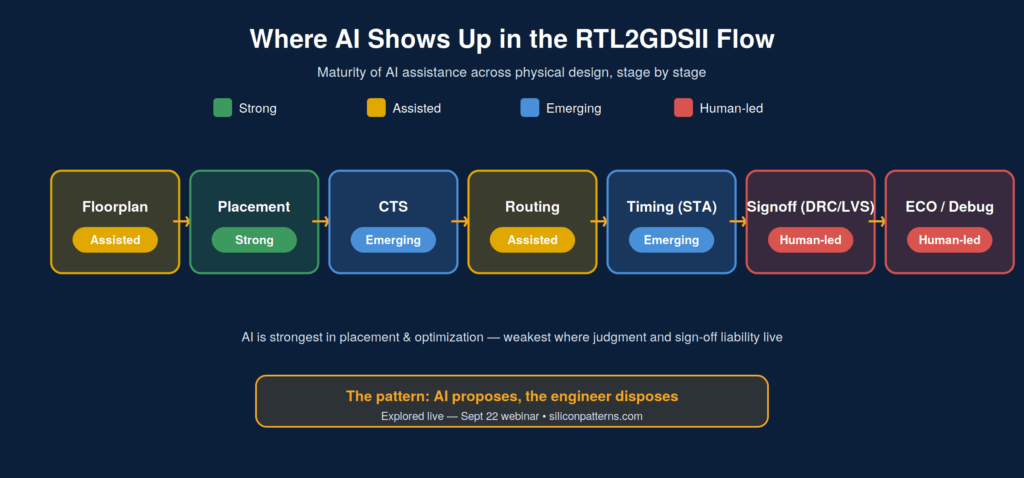
Placement is where AI in physical design is strongest today. Deciding where hundreds of thousands or millions of instances go is a search problem across an astronomically large space, and machine learning is very good at searching such spaces faster and often better than exhaustive heuristics. Routing congestion prediction is close behind — models can now flag where you’ll have trouble before the router even runs, which saves entire iteration loops.
Move toward the other end of the chain and the picture changes. Sign-off — DRC, LVS, the checks that say a chip is actually manufacturable — remains firmly human-led, not because the pattern-matching is hard, but because someone has to own the liability when a mask set costs seven figures. ECO and deep debug stay human too, for a reason we’ll come back to: AI can tell you what looks wrong far better than it can tell you why, and physical design debugging is almost entirely a why problem.
Strip away the hype and there’s a real, unglamorous list of things machine learning already does well enough to change your schedule. This isn’t the future — teams are shipping with it now.
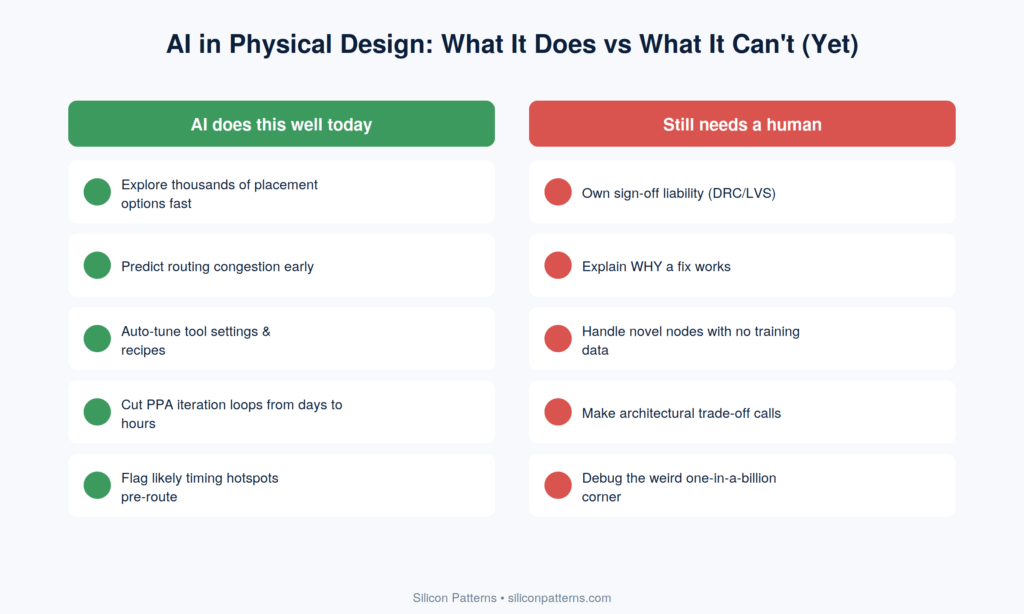
The biggest wins are about speed of exploration. An AI-assisted flow can explore thousands of placement or floorplan options in the time a human would try a handful, predict routing congestion early enough to fix it cheaply, auto-tune the dozens of tool settings that engineers used to adjust by intuition, and compress PPA (power, performance, area) iteration loops from days into hours. None of these is glamorous. All of them attack the exact part of the job that used to eat nights and weekends — babysitting long tool runs and grinding through iterations by hand.
That’s the honest value proposition of AI in physical design right now: it doesn’t invent your design, it removes the drudgery between your decisions.
Here’s the part the demos skip. The right-hand column above isn’t a list of things AI will conquer next quarter — several of those limits are structural, and understanding why they persist tells you a lot about how to use these tools safely.
AI can’t own sign-off liability, because accountability isn’t a technical capability — it’s a human and contractual one. It struggles to explain why a fix works, and in debug that’s often the whole task, since a change that fixes a symptom without addressing the cause is how you ship a subtle bug to silicon. It has little to offer on genuinely novel nodes where no training data exists yet — models are only as good as what they’ve seen. And it doesn’t make architectural trade-off calls, because those require weighing business context an optimizer simply doesn’t have.
The through-line is judgment. Everywhere physical design reduces to search and optimization, AI is strong and getting stronger. Everywhere it reduces to judgment, causal reasoning, or accountability, the engineer is still the whole game. Knowing which stage is which is the practical skill of the moment.
The anxious question underneath all of this is the obvious one: does AI in physical design mean fewer physical design engineers? Our honest read is no — but it does mean the job changes, and the engineers who thrive will be the ones who lean into that change rather than resist it.
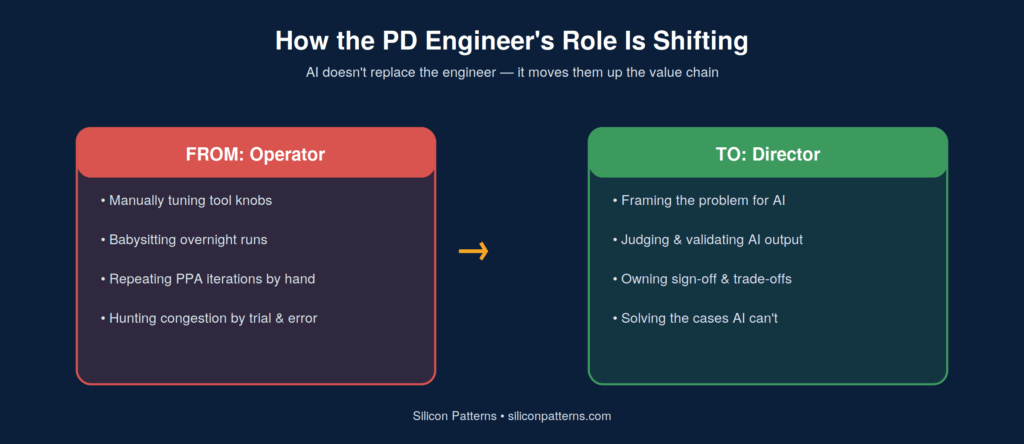
The old version of the job had a lot of operator in it — manually tuning knobs, babysitting overnight runs, repeating iterations, hunting congestion by trial and error. AI is quietly eating those tasks. What it leaves behind, and amplifies, is the director work: framing the problem well enough for the AI to help, judging and validating what it produces, owning the sign-off and the trade-offs, and personally solving the cases the AI can’t. The pattern that keeps showing up across the flow is a simple one — AI proposes, the engineer disposes. The tool generates options at superhuman speed; the human decides which one is actually right and takes responsibility for it. That’s not a smaller job. In many ways it’s a more senior one.
Yes — but it’s a helpful ghost, not a replacement, and it haunts some rooms of the house far more than others. It’s genuinely present and useful in placement, congestion prediction, and PPA optimization. It’s an apprentice, not a master, in clock tree synthesis and timing. And it’s essentially absent where accountability and causal reasoning live — sign-off, novel-node work, and the hard debug. Teams that understand that map are already pulling real schedule and quality gains from AI in physical design. Teams that believe the marketing version tend to either overtrust the tool and get burned at sign-off, or dismiss it entirely and leave easy wins on the table. The winning move is neither hype nor cynicism — it’s a clear-eyed sense of exactly which stage you’re in and what the tool can honestly be trusted with there.
A blog can only sketch this. The interesting part is in the specifics — which tools, which stages, what actually broke, and what the results looked like on real designs — and that’s a conversation, not an article.
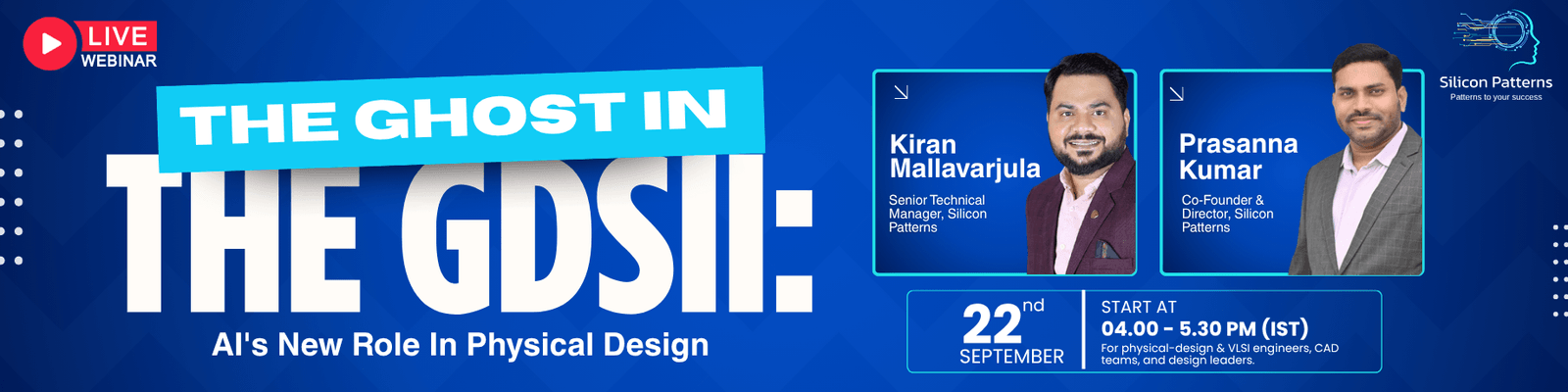
That’s exactly what we’re doing live in The Ghost in the GDSII: AI’s New Role in Physical Design.
Here are the essentials:
Every registrant gets the recording and slide deck afterwards, so it’s worth registering even if the time is awkward for your zone. You can register free on our webinar page — bring your hardest question about AI in physical design and put it to people who run the flow for a living.
Is AI in physical design actually used in production, or is it still research? Both, depending on the stage. Placement optimization, routing-congestion prediction, and tool-setting auto-tuning are used in production flows today. Sign-off, novel-node work, and deep debug remain human-led. The honest answer is that AI assists specific stages well and leaves others largely untouched.
Will AI replace physical design engineers? Our view is no — but the role shifts from operating the tools toward directing them: framing problems, validating AI output, owning sign-off and trade-offs, and solving the cases AI can’t. It tends to make the job more senior, not redundant.
Which physical design stage benefits most from AI today? Placement, because it’s a massive search problem where machine learning excels, followed closely by routing-congestion prediction and PPA optimization — the stages that are combinatorial and tolerant of “good enough” solutions.
Why can’t AI handle sign-off? Partly technical, mostly accountability. Sign-off (DRC/LVS) is where responsibility for a manufacturable chip lives, and when a mask set costs seven figures, a human has to own that call. AI can assist the checks, but it can’t carry the liability.
Do I need to attend the webinar live to get value? No — every registrant receives the full recording and slide deck. Registering also gives you access to live Q&A if you can make it, but the replay is the single best reason to sign up even if the timing doesn’t suit you.
AI in physical design is neither the magic box the marketing promises nor the empty hype the skeptics claim. It’s a genuinely useful assistant that’s strong where the work is search and optimization, weak where it’s judgment and accountability, and quietly reshaping the engineer’s role from operator to director. The ghost in the GDSII is real — it’s just important to know exactly which rooms it lives in.
If you want the detailed, no-hype version straight from engineers who run RTL-to-GDSII on real silicon, join us live on 22 September — or register anyway for the recording and bring your toughest question.

From ASIC architecture to GDSII tape-out — talk to our engineering team today.
Let’s Build Your Next Chip Together.