
Inactive
Simplifying IT
for a complex world.
Platform partnerships
- AWS
- Google Cloud
- Microsoft
- Salesforce

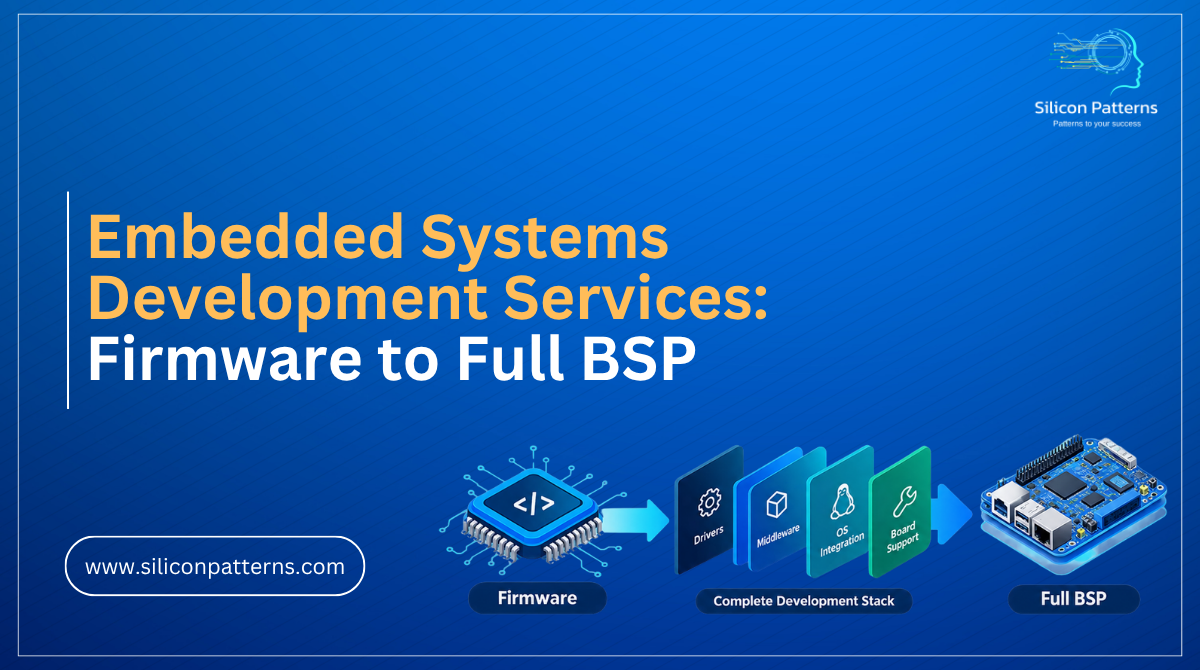
Someone says the word “firmware” in almost every hardware project, and everyone in the room nods like they mean the same thing. They rarely do. A product manager might picture “the software that makes the device work.” The engineer who has to deliver it might picture something else entirely — anything from a single application task on an existing board to writing a bootloader, porting Linux, and bringing up drivers for hardware that’s never booted before.
That gap causes more scoping disasters than almost anything else in embedded projects. A team quotes “firmware development.” The client assumes it includes board bring-up. Three months in, everyone discovers they were never talking about the same job.
This is the plain-language version instead: what embedded systems development services actually cover, layer by layer, from a narrow firmware task up to a full board support package. Scoping an embedded engagement — your own team, an outsourced partner, or some mix of both — starts with this vocabulary and this reality check, before anyone writes an SOW.
Before talking about scope, it helps to see the whole picture. Every embedded product is a stack of layers, and each one is a genuinely different kind of engineering.
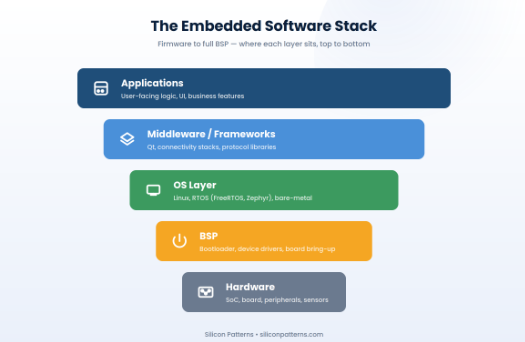
The stack, top to bottom. “Firmware” usually means the lower three layers — and each is its own discipline.
The applications layer sits on top — the user-facing logic that makes the product do its job. Below that comes middleware and frameworks: connectivity stacks, protocol libraries, GUI toolkits. Next is the OS layer — Linux, an RTOS like FreeRTOS or Zephyr, or bare-metal code with no OS at all. Then the BSP: bootloader, device drivers, board bring-up, the layer that brings a specific chip on a specific board to life. Underneath everything sits the hardware itself.
Here’s the part people miss: work at the top of that stack and work near the bottom are almost different professions. An application engineer writing business logic rarely opens a datasheet. A BSP engineer bringing up a new SoC lives in datasheets, oscilloscopes, and boot logs, debugging problems with no stack trace because the OS hasn’t finished booting yet. Knowing which layer your project actually needs is the first and most important scoping decision you’ll make. Our embedded systems engineering page covers the full discipline in more depth, if you want the deeper engineering view of how we run this end to end.
Used loosely, “firmware” can mean almost anything below the application layer. Used precisely, it usually means the code running closest to the hardware — reading sensors, driving actuators, managing timing-critical operations, talking to peripherals over I2C, SPI, or UART.
Firmware-only engagements are the narrowest and fastest scope. They make sense in one specific situation: you already have a working board and a functioning BSP, and you need the logic that runs on top of it. A working board with existing drivers just needs someone to add a feature or a sensor-fusion algorithm — a firmware task, cleanly scoped, quick to quote, quick to deliver.
The trap is assuming firmware-only covers a new custom board. It doesn’t. Nothing has ever booted on that hardware yet, so you need the layer beneath firmware first — and that’s where BSP work begins.
This phrase gets underscoped more than any other in embedded projects, so it’s worth spelling out completely. A board support package isn’t a single deliverable. It’s a collection of distinct engineering tasks that together let an operating system, and everything above it, run on a specific piece of hardware.
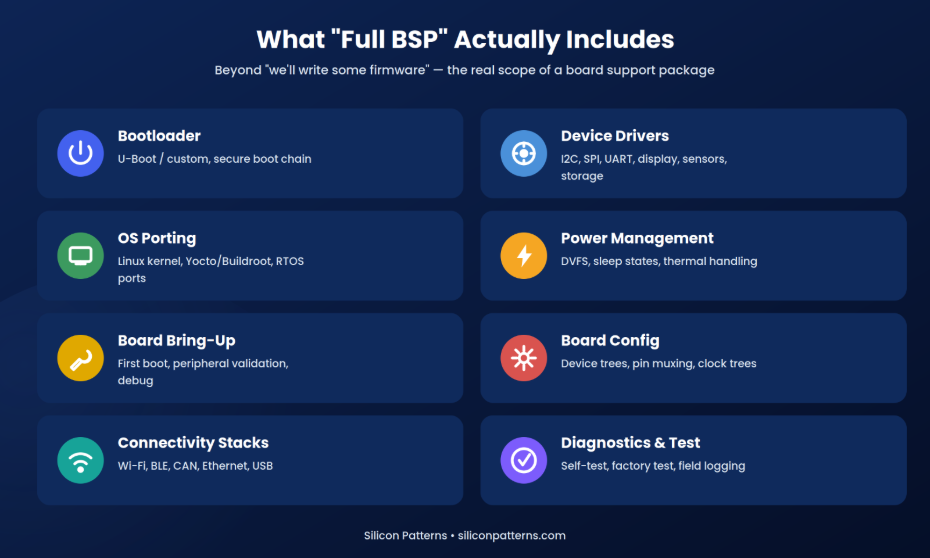
Eight things “full BSP” actually means. A quote that only covers two or three of these isn’t a full BSP — it’s a partial one.
Bootloader work — U-Boot or a custom bootloader, often with a secure boot chain — gets the processor from power-on to a running kernel. Device drivers connect the OS to every physical interface on the board: I2C, SPI, UART, display, sensors, storage. OS porting means getting Linux (often via Yocto or Buildroot) or an RTOS actually running on your specific silicon, not just “supported in general.” Power management covers DVFS, sleep states, and thermal handling — invisible until battery life comes in at half what you promised.
Board bring-up is the messy, hands-on work of getting a brand-new board to boot for the first time and validating every peripheral against real hardware. Board configuration — device trees, pin muxing, clock trees — is the unglamorous plumbing that tells software exactly how a board is wired. Connectivity stacks bring up Wi-Fi, BLE, CAN, Ethernet, or USB. Diagnostics and test — self-test routines, factory test modes, field logging — lets you actually manufacture and support the product at scale.
Walk a prospective partner through this list, item by item. A quote covering only three or four of these isn’t a full BSP, whatever the proposal calls it — and finding that gap after your hardware has shipped is an expensive way to learn it.
Once the layers are clear, scoping becomes a much simpler conversation. Most embedded work falls into one of three shapes.
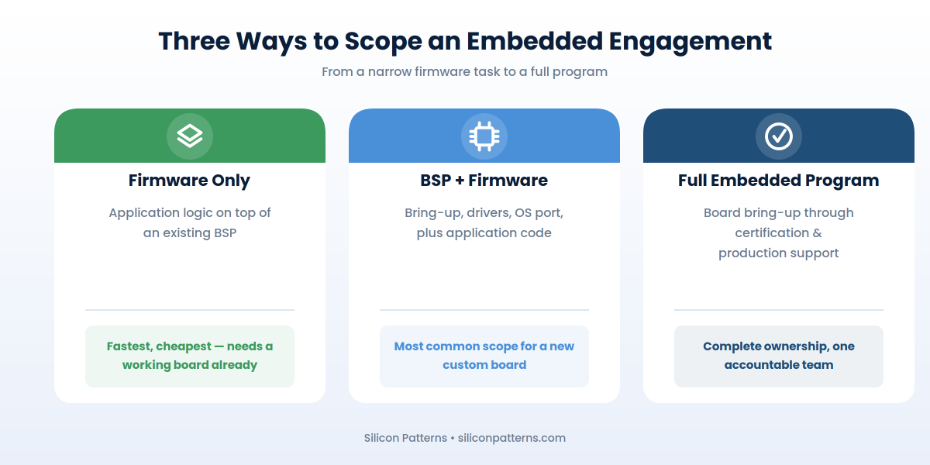
Match the scope to what you actually have. The biggest cost overruns happen when a firmware-only quote gets asked to do BSP work.
A firmware-only engagement fits when your board already works and you need application-layer logic on top of it — the fastest and cheapest path, but only when the hardware foundation is genuinely solid. A BSP-plus-firmware engagement is the most common shape for a new custom board: bring-up, drivers, OS port, and the application code that runs on top, delivered as one coherent scope. A full embedded program carries everything from first board bring-up through certification and production support — the right shape when you want one accountable team instead of a stack of hand-offs between a hardware house, a driver specialist, and an app developer.
That last option matters more than people expect. Splitting BSP and firmware across separate vendors creates exactly the integration risk that causes the most painful delays — a driver bug that looks like an application bug, or a power-management issue nobody owns because it touches both layers. Full ASIC and SoC programs teach the same lesson: fragmenting a build across vendors creates seams, and seams are where schedules die. Our turnkey ASIC solutions approach carries that same one-team philosophy from silicon through the embedded software running on it, for products where the chip and the firmware get built together.
The layers above apply everywhere, but the specifics — the certifications, the reliability bar, the constraints — shift enormously by domain.
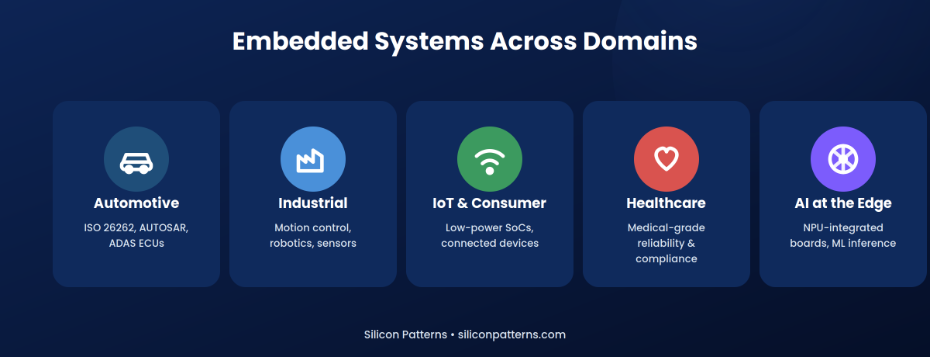
Same stack, very different rules depending on the domain.
Automotive work lives under ISO 26262 and AUTOSAR, where a driver bug isn’t just a bug — it’s a functional-safety finding. Industrial systems demand real-time determinism for motion control and robotics, where a missed deadline can damage a machine. IoT and consumer products live and die by power budget and cost — every extra milliamp or extra cent on the bill of materials matters at volume. Healthcare devices carry their own compliance and reliability bar, often with years of field life to support. AI at the edge is the newest frontier: boards with an integrated NPU need BSP and driver work that understands inference pipelines, not just traditional peripherals.
A partner who’s only ever worked in one of these domains brings assumptions that don’t transfer. Ask directly about relevant domain experience before assuming “embedded experience” is one interchangeable skill.
Never accept a quote for “embedded development,” or even “firmware development,” without agreeing in writing exactly which layers of the stack it covers. Walk through the eight BSP components together. Confirm whether board bring-up is included, or just assumed to already be done. Find out what happens if bring-up surfaces a hardware issue — who owns that conversation, and does it blow the budget or sit inside the scope already.
Smooth projects share one trait: everyone agreed on the layer boundaries before any code was written. Rocky projects share the opposite one — “firmware” quietly meant two different things to two different people.
Firmware typically means the application-level code running on hardware that already boots. A BSP (board support package) covers everything below that — bootloader, drivers, OS port, and board bring-up — the pieces that make the OS and firmware possible on a specific board in the first place. Full BSP work includes firmware; firmware-only work assumes the BSP already exists.
Complexity drives the range, but a realistic estimate for a new custom board with Linux and standard peripherals runs 3–6 months, longer for automotive-grade or highly custom hardware. Board bring-up itself — first boot to stable peripherals — tends to be the least predictable phase, since it depends on what the hardware actually does versus what the schematic says it should do.
Your requirements decide this one. Linux suits products needing rich connectivity, a filesystem, or complex applications, at the cost of more resources and a slower boot. An RTOS like FreeRTOS or Zephyr suits real-time, resource-constrained, or safety-critical work where deterministic timing outweighs feature breadth. Plenty of products use both — an RTOS on a real-time core, Linux on an applications core.
Yes, and teams do this often. BSP work demands deep hardware-specific expertise that’s expensive to build for a single project, while application logic often benefits from staying close to your product team. The key is a clean, well-documented handoff at the driver and OS layer, so your in-house team never has to guess at undocumented behavior.
Request a specific board they’ve brought up from scratch, not just “experience with your SoC family.” Find out how they handle a hardware issue discovered mid-bring-up. Check whether BSP and firmware sit with one accountable team or get handed between specialists. Domain-specific experience matters too — automotive, industrial, and consumer embedded work each carry a genuinely different discipline.
Embedded systems development services aren’t one thing — they’re a stack, and the biggest source of budget and schedule pain comes from scoping the wrong layer, or assuming a quote covers layers it doesn’t. Get specific about firmware versus BSP versus a full program before signing anything, and you’ll dodge the single most common way embedded projects go sideways. Scoping a board — from first bring-up through production firmware — is exactly what our embedded systems engineering services cover. Send us your board and requirements, and we’ll tell you honestly which layers you actually need.

From ASIC architecture to GDSII tape-out — talk to our engineering team today.
Let’s Build Your Next Chip Together.