

Inactive
Simplifying IT
for a complex world.
Platform partnerships
- AWS
- Google Cloud
- Microsoft
- Salesforce

A few years back, a client came to us with a half-finished SoC and a familiar story. Vendor one did the architecture. Vendor two wrote most of the RTL. Vendor three was supposed to verify it — and quit the engagement when they saw what they’d inherited. Eighteen months in, nobody could say with confidence whether the chip worked, because nobody owned the whole picture.
That project eventually shipped. But it cost nearly double the original budget, and the most expensive line item wasn’t engineering hours. It was the decision made on day one: choosing partners by rate card instead of by fit.
If you’re evaluating SoC design services in 2026, this guide is the conversation we wish every client had before signing anything — what an SoC program actually demands, where vendors quietly differ, and the specific questions that separate a real partner from a body shop.
An SoC — system on chip — isn’t one design. It’s a negotiation between many: CPU cores, accelerators, memory controllers, high-speed interfaces, power management, security blocks, and the interconnect fabric that has to keep all of them talking without deadlocking or starving anyone of bandwidth.
That’s the part outsiders underestimate. Designing any single block is a solved problem. Integrating thirty of them — some designed in-house, some licensed as third-party IP, some inherited from a previous chip — into one coherent, verifiable, power-managed system is where SoC design services earn their keep or reveal their limits.
It’s also why SoC work punishes fragmented outsourcing harder than simpler ASIC projects do. Interfaces between blocks are exactly where bugs hide, and interfaces between vendors are where accountability hides. (If you want the full stage-by-stage flow from spec to GDSII, we’ve covered that separately in our ASIC design services guide — this article focuses on the partner decision.)
SoC engagements also rarely stop at silicon. Most programs need board bring-up, firmware, and driver work, which is why it helps to choose a partner whose semiconductor design services extend beyond the chip into embedded software and system validation.
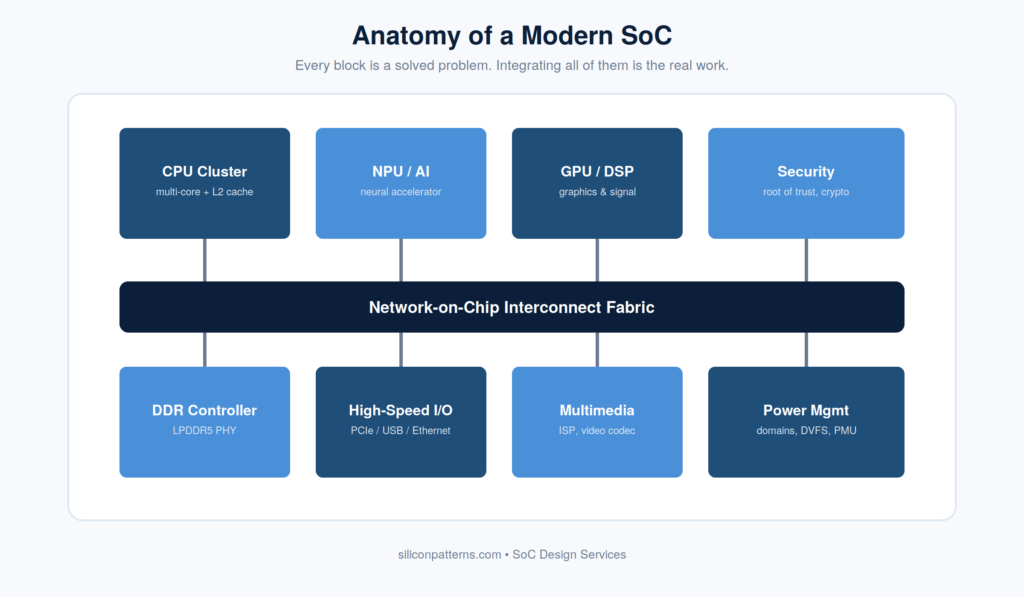
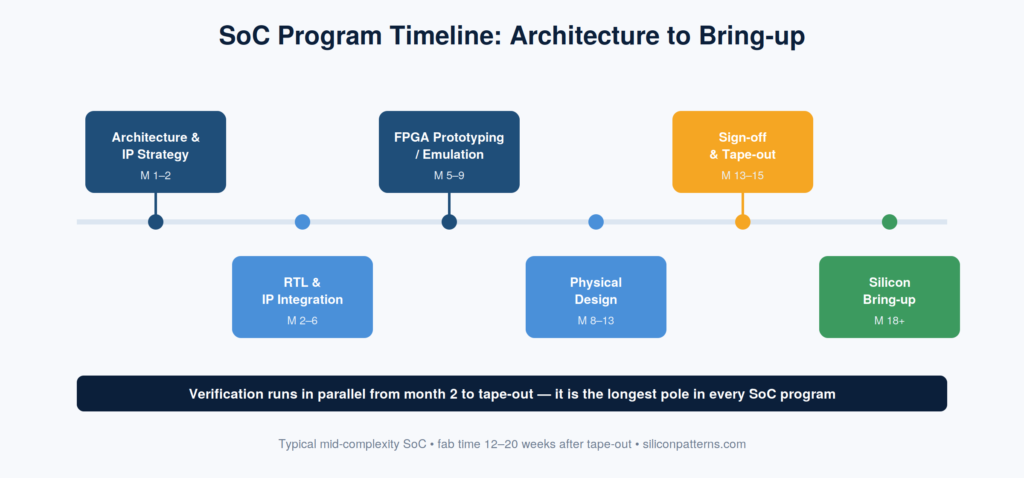
When vendors say “end to end,” probe what that means. A complete program spans:
Architecture and IP strategy. Deciding what to build, what to buy, and on which node. This stage sets 80% of your cost and risk. A good partner will sometimes talk you out of scope — we’ve advised clients to drop a custom block in favor of proven licensed IP more than once, even though building it would have billed more hours.
RTL integration and subsystem design. Stitching owned and licensed IP into the fabric, with clean clock and reset architecture across dozens of domains.
Verification at two levels. Block-level UVM environments, then system-level verification where the real monsters live: cache coherency corner cases, power-state transitions, interconnect deadlocks. On a healthy SoC program, verification headcount exceeds design headcount — if a vendor’s team sheet shows the opposite, that’s not efficiency, that’s a future re-spin.
Software readiness before silicon. FPGA prototyping or emulation so firmware teams boot code months before tape-out. In our experience this single practice does more to protect schedules than any other, because it turns “the chip is back, now let’s see” into “the chip is back, and the software already runs.”
Physical design through sign-off. Floorplanning a large SoC is a different sport from a small ASIC — power domains, multiple voltage islands, and timing closure across a die where signals genuinely take multiple clock cycles just to cross.
Post-silicon bring-up. Lab validation, characterization, and the unglamorous debugging that turns first silicon into shippable product.
We’ve sat on both sides of these evaluations. These are the questions that produce the most honest signal, fastest:
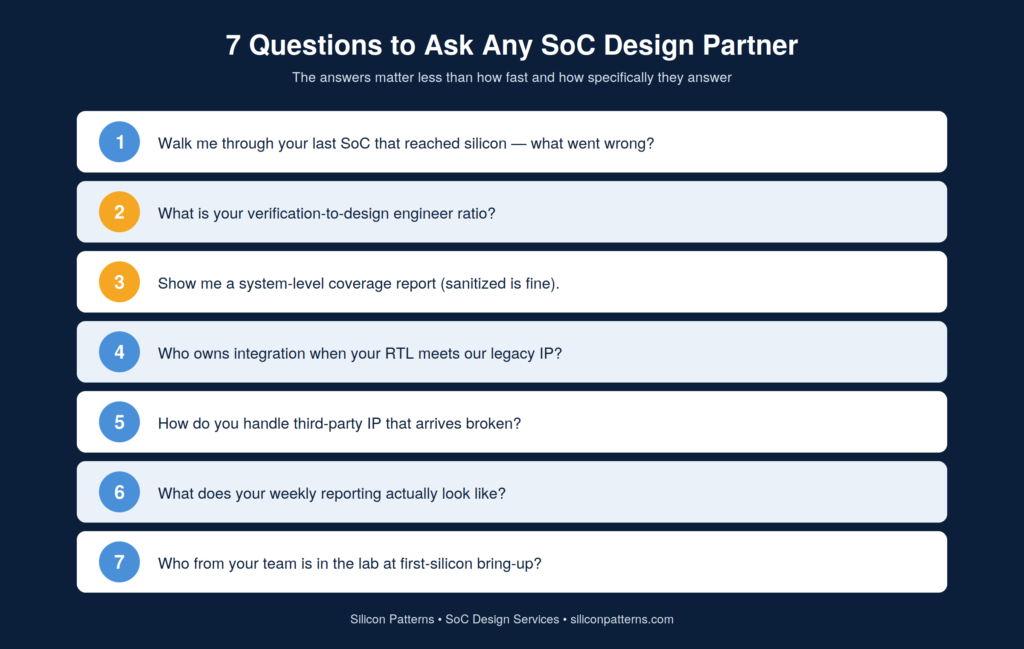
1. “Walk me through your last SoC that reached silicon. What went wrong?” Every real program has scars. A vendor who claims a flawless history is either new or careful with the truth. What you want is a specific story and what they changed afterward.
2. “What’s your verification-to-design engineer ratio on SoC programs?” Anything below 1:1 on a complex SoC deserves a follow-up question. The best teams run closer to 2:1.
3. “Show me a system-level coverage report — sanitized is fine.” Teams that live coverage-driven verification can produce one in a day. Teams that can’t will send a methodology slide instead.
4. “Who owns integration when your RTL meets our legacy IP?” The answer must be a name, not a diagram. Shared ownership is no ownership.
5. “How do you handle third-party IP that arrives broken?” It happens on nearly every SoC. Experienced partners have a debug-and-escalate playbook; inexperienced ones burn weeks proving whose bug it is.
6. “What does your weekly reporting actually look like?” Ask for a real (redacted) status report from a live project. Regression pass rates and open-bug trends beat traffic-light slides.
7. “Who from your team is in the lab at first-silicon bring-up?” If the engagement model ends at GDSII hand-off, you’re hiring a subcontractor, not a partner.
At Silicon Patterns, we encourage prospects to put us through exactly this list — partly because we do well on it, and partly because a client who asks hard questions early is a client whose project will go well.
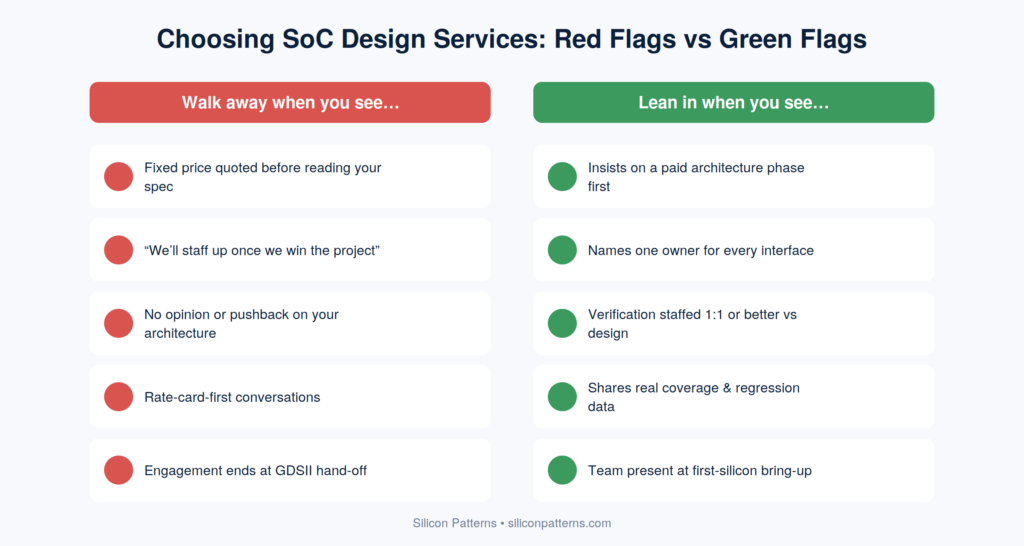
A few patterns we’ve seen precede troubled programs often enough to call them rules:
Three models dominate, and the right one depends on how well-defined your spec is:
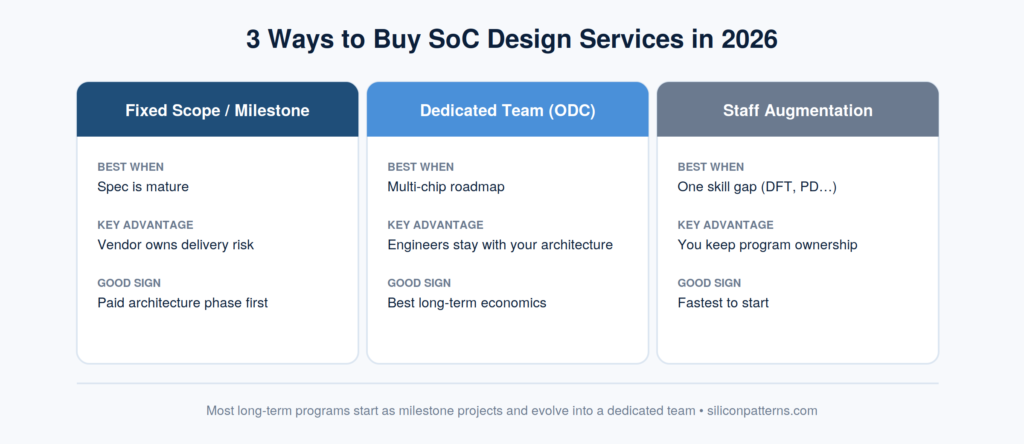
Most of our long-running client relationships evolve from the first model into the second — a milestone project builds trust, then a dedicated team carries the roadmap.
Choosing among SoC design services isn’t really a procurement decision — it’s choosing who you’ll be debugging with at 2 a.m. when first silicon does something nobody predicted. Optimize for silicon-proven experience, verification depth, single-point ownership, and a partner who’s still in the room after tape-out. The rate card will take care of itself.
If you’re scoping an SoC program and want a partner who’s answered all seven questions above with real projects, start with our semiconductor design services overview — or send us your spec, however early, and we’ll give you an honest read on scope, schedule, and where the risk actually lives.

From ASIC architecture to GDSII tape-out — talk to our engineering team today.
Let’s Build Your Next Chip Together.