Inactive
Simplifying IT
for a complex world.
Platform partnerships
- AWS
- Google Cloud
- Microsoft
- Salesforce

Choosing an ASIC design company is one of those decisions that looks like procurement and turns out to be something much bigger. You’re not buying engineering hours. You’re choosing who you’ll be on the phone with at 2 a.m. when first silicon comes back and does something nobody predicted — and whether that person stays calm and fixes it, or goes quiet and starts explaining whose fault it isn’t.
We’ve been on both sides of these evaluations. We’ve pitched for programs, and we’ve been called in to rescue programs that went to the wrong partner first. The pattern is remarkably consistent: the projects that succeed almost always chose their ASIC design company on the same handful of things, and the projects that stalled almost always got dazzled by a rate card or a slick deck instead.
So here’s the checklist we’d hand a friend who was about to sign. Twelve points, in the order they actually matter. Work through them and you’ll know far more about a potential partner than any sales conversation will tell you.
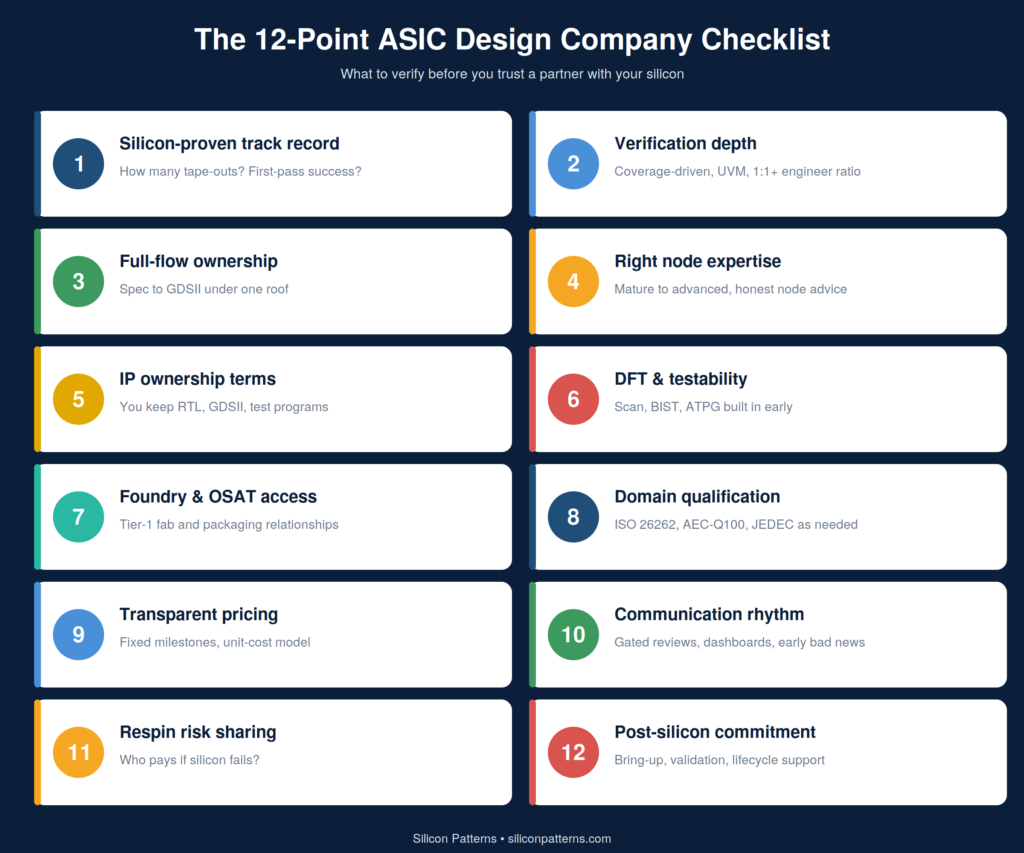
Start here, because everything else is theory until a company has actually shipped silicon. Ask a blunt question: how many designs have you taken all the way to working silicon, on which process nodes, and how many worked on first pass?
What you want is a specific answer with real numbers, not a carousel of logos. Any ASIC design company can show you a capabilities deck. Far fewer can tell you they run five or more tape-outs a year and mean it. A partner’s silicon record should speak before their marketing does.
If there’s one thing that separates the companies that ship working chips from the ones that ship expensive coasters, it’s verification. On a healthy program, verification is the single largest slice of effort — often a third of the whole budget — because proving a chip works across every scenario is genuinely harder than making it work once.
Ask two things: what’s your verification-to-design engineer ratio, and can I see a sanitized coverage report from a past project? A serious company runs verification at least 1:1 against design, often closer to 2:1, and can produce a coverage report in a day. A company that treats verification as a box to tick is quietly setting you up for a re-spin.
Here’s a failure mode we see constantly: a design gets split across three vendors — one for RTL, one to broker the foundry, one for test — and the seams between them are exactly where quarters quietly disappear. Interfaces between blocks are where bugs hide. Interfaces between vendors are where accountability hides.
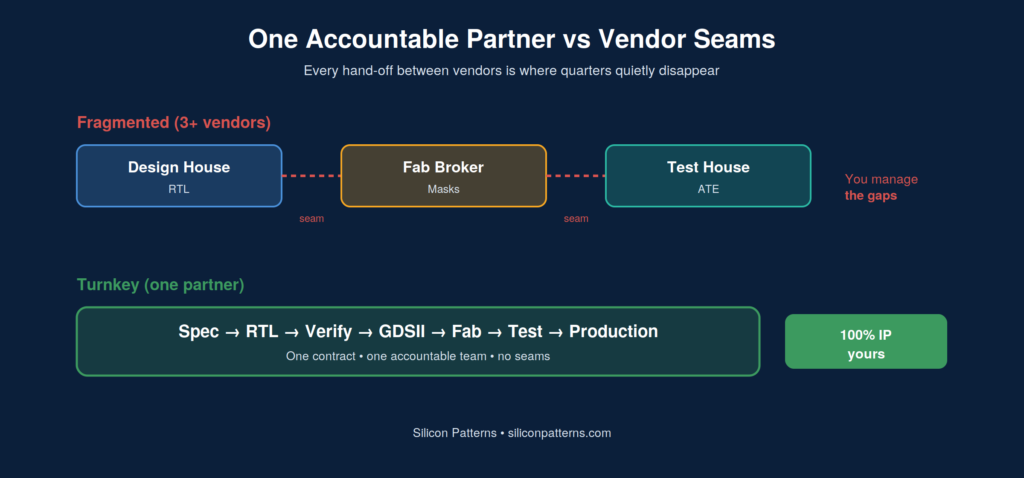
The strongest ASIC design companies carry a design from specification all the way through sign-off — and increasingly through fabrication, test, and production — under one accountable contract. That’s the whole idea behind a turnkey ASIC solution: spec in, silicon out, one team that owns every stage in between so you’re never the one integrating three vendors’ half-finished work.
The single most expensive mistake in custom silicon is over-specifying the process node. We’ve watched well-funded teams burn half a budget chasing 5nm for a product that would have shipped beautifully on 28nm.
A good ASIC design company works across mature and advanced nodes — and, crucially, will talk you out of an expensive node when your product doesn’t need it. If a company only ever steers you toward the bleeding edge, ask yourself whether they’re optimizing for your product or their invoice. Honest node advice is one of the clearest signs of a partner rather than a vendor.
This one is buried in contracts and it matters enormously. When the program is done, who owns the RTL, the GDSII, the test programs, and the documentation?
The answer you want is simple: you do, completely. A trustworthy ASIC design company hands you the full design database so you’re never locked to them, ideally with a third-party escrow option on top. Vague or evasive IP language is a genuine red flag — it means the leverage stays with them, not you.
Design-for-test — scan chains, BIST, ATPG — is what lets every chip coming off the production line be screened for manufacturing defects. Inexperienced teams treat it as an afterthought, and it shows up later as chips that can’t be tested economically or, worse, defective parts reaching your customers.
Ask whether DFT is architected early, in parallel with design, rather than bolted on at the end. Expect a competent partner to target 98%+ stuck-at fault coverage with a clear plan for at-speed testing.
An ASIC design company that stops at GDSII and hands you a foundry’s phone number has left you with a large, unglamorous problem: managing wafer fabrication and packaging yourself. Established partners bring tier-1 foundry relationships and qualified OSAT (packaging and test) partners to the table, along with access to MPW shuttle programs that can dramatically lower prototyping cost.
This is the difference between a design house and a partner who can actually get chips into your hands.
A chip for a toy and a chip for a car live in completely different worlds. If your product touches automotive, you need a company fluent in ISO 26262 and AEC-Q100. Medical, industrial, and aerospace each bring their own qualification regimes and lifetime requirements.
Ask whether the company applies functional-safety discipline as a matter of course, not just on the programs that strictly require it. Teams that bake that rigor into everything tend to produce more robust silicon across the board.
Beware any ASIC design company that quotes a fixed price before reading your spec — serious estimation takes days of engineering review, not a sales call. What you want instead is a partner who offers a proper feasibility study: node recommendation, block-level architecture, die-size estimate, an NRE breakdown, and unit cost at your real volumes.
That last part matters. Hourly rates predict almost nothing about total program cost. First-pass silicon at a higher rate is dramatically cheaper than a re-spin at a lower one. Insist on a cost model your CFO can actually act on.
Silence in a silicon program is never good news. The best ASIC design companies run on a visible cadence: gated stage reviews you approve before work proceeds, regression dashboards you can check without asking, and bad news delivered early rather than buried.
Ask to see a real (redacted) status report from a live project. Regression pass rates and open-bug trends tell you far more than a traffic-light slide ever will. A gated program is also something you can put in front of your board with confidence.
This is the question most buyers forget to ask, and it’s one of the most revealing. If first silicon fails because of a design defect, who pays for the re-spin?
A confident, silicon-proven ASIC design company will have an answer defined in the contract before the work starts: defects traceable to their design work are corrected at their cost. A company that gets vague here is telling you they’re not confident in their own verification — and that the risk allocation will get argued after the fact, when it’s most expensive to resolve.
The last point, and the one that separates a subcontractor from a partner. Who from the company is in the lab when first silicon arrives? First silicon always does something unexpected, and the teams that budgeted bring-up, characterization, and validation sail through while the ones who treated tape-out as the finish line scramble.
A real partner treats bring-up as part of the job, not an add-on — and stays engaged through qualification, yield ramp, and the years your product actually ships. An engagement that ends at GDSII hand-off was never really a partnership.
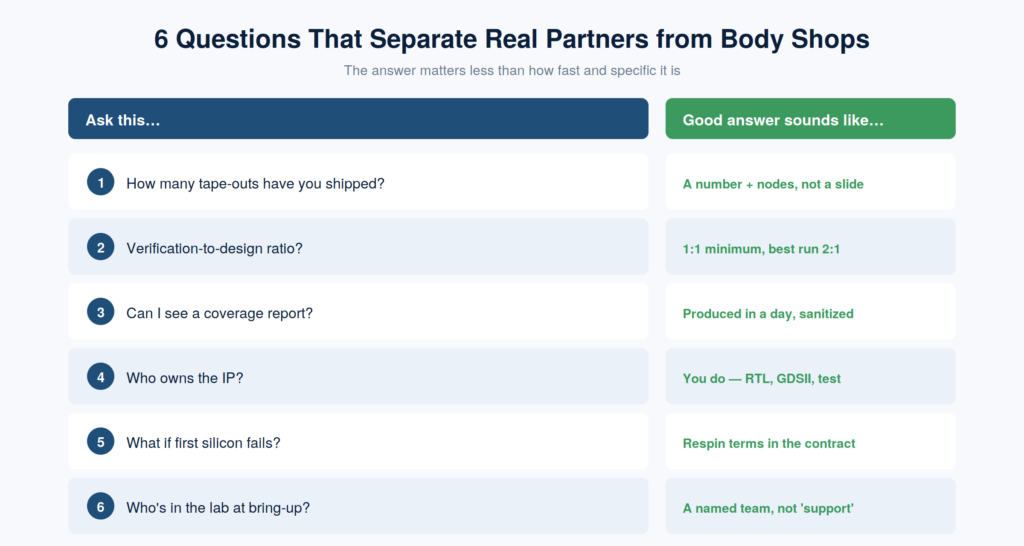
Reading a checklist is easy; using it in a vendor call is where it pays off. Here are six of the twelve points rephrased as questions you can ask directly — and what a strong answer actually sounds like.
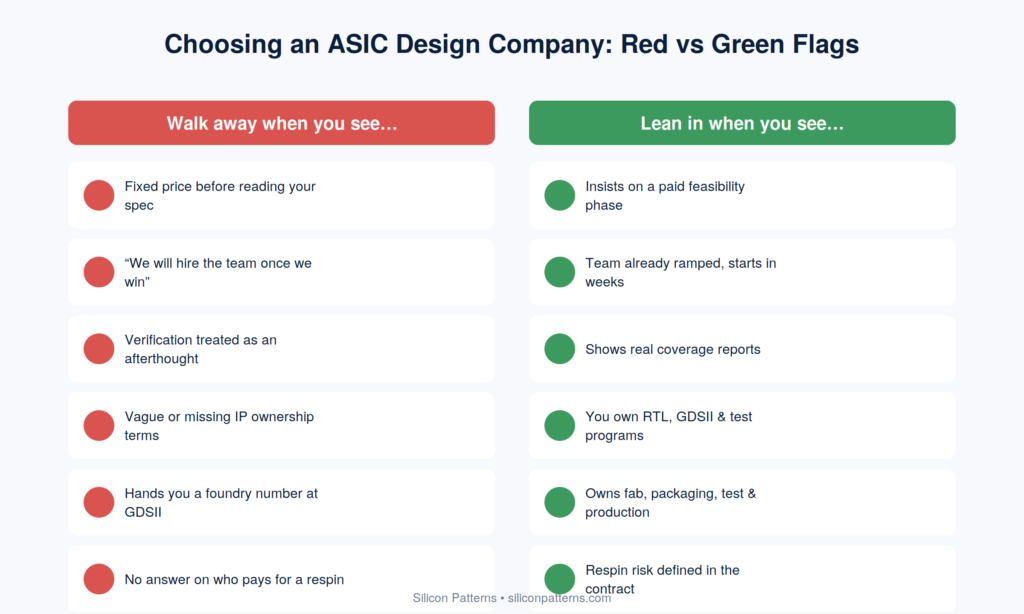
If you remember nothing else, remember the shape of the two companies you’re choosing between.
.
How do I evaluate an ASIC design company with no chip experience of my own? Lean on the objective signals rather than technical debate: tape-out count and first-pass success rate, verification-to-design ratio, willingness to share a coverage report, clear IP-ownership terms, and defined respin responsibility. A trustworthy partner will also offer a feasibility study that educates you rather than rushing you to sign.
Is a bigger ASIC design company always better? Not necessarily. What matters is silicon-proven experience on nodes and domains relevant to your product, verification depth, and single-point accountability. A focused team that ships five tape-outs a year and owns the full flow can serve you better than a large firm that will fragment your program across departments.
Should I choose a turnkey ASIC company or a design-only house? It depends on how much of the journey you want to own. If you have a product idea but no path to silicon, a turnkey ASIC partner who carries you from spec to shipped, qualified parts under one contract removes the vendor seams where programs stall. If you already have an internal team and just need to fill a gap — say verification or physical design — a scoped engagement may fit better.
What does an ASIC design company actually cost? It varies enormously with node and complexity, from around $0.5M–$1.5M for a mature-node mixed-signal chip to well over $10M at advanced nodes. The honest way to find your number is a feasibility study that models NRE and unit cost at your target volumes — not a single figure quoted before anyone has read your spec.
What’s the most common mistake companies make when choosing? Optimising for hourly rate instead of total program cost. A cheaper rate that leads to a re-spin is far more expensive than a higher rate that lands first-pass silicon. The checklist above is designed to keep you focused on what actually drives cost and risk.
Choosing an ASIC design company comes down to a simple idea: look for silicon-proven experience, verification depth, single-point accountability, clear IP ownership, and a partner who’s still in the room after tape-out. The rate card will take care of itself. Get those things right, and you dramatically improve your odds of first-pass silicon; get dazzled by a deck instead and you risk becoming one of the rescue programs that come to us a year too late.
If you’re weighing a custom chip and want a partner who scores well on all twelve points — one accountable team from spec to shipped silicon, with 100% of the IP staying yours — explore our turnkey ASIC solutions, or send us your requirement, and we’ll give you an honest read on scope, cost, and schedule.

From ASIC architecture to GDSII tape-out — talk to our engineering team today.
Let’s Build Your Next Chip Together.