
Inactive
Simplifying IT
for a complex world.
Platform partnerships
- AWS
- Google Cloud
- Microsoft
- Salesforce

Every company that decides to build a custom chip eventually hits the same fork in the road: do we build the design team ourselves, or do we hand it to a partner? And almost everyone gets the cost question wrong the first time — because they compare the wrong numbers.
The instinct is to line up an in-house engineer’s salary against an outsourced firm’s hourly rate and call it a day. But that comparison misses almost everything that actually costs money. It ignores the twelve to eighteen months you’ll spend recruiting a chip team before anyone writes a line of RTL. It ignores the million-dollar-a-year EDA tool licenses. It ignores the silicon-proven IP you either license or rebuild from scratch, the foundry accounts you set up from zero, and the fixed overhead you pay every month whether or not you ever tape out.
This is an honest cost comparison of in-house versus outsourced chip design services — the full picture, not the sticker price. If you’re trying to decide which model your product and budget can actually support, this is the math you need before you commit.
Chip design services cover the end-to-end engineering that turns a product idea into manufacturable silicon: architecture, RTL design, verification, physical design, DFT, and tape-out to a foundry. You can source that capability two ways.
In-house means you hire the engineers, buy the tools, license the IP, and own the entire operation. Outsourced means you engage a specialist firm that already has all of that in place and delivers the design (or the finished chip) under contract.
Both are legitimate. Which one wins for you depends far less on rate cards than on your volume, your roadmap, and how much fixed cost your business can absorb. Let’s put the two side by side.
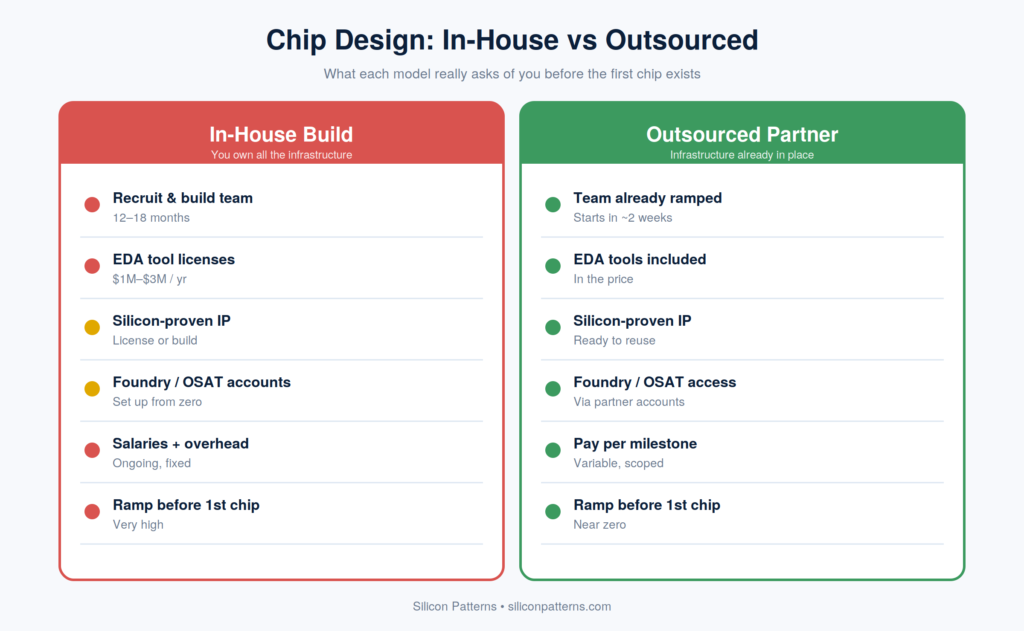
Here’s what the salary-versus-rate comparison quietly leaves out. Building an in-house chip design capability isn’t just hiring engineers — it’s standing up an entire infrastructure, most of which you pay for long before you have anything to show for it.
The team-build itself takes 12–18 months. Experienced VLSI engineers — especially in verification and physical design — are scarce and slow to hire. That’s a year or more of runway spent before your first project even starts.
EDA tool licenses run into the millions. A full flow of Synopsys and Cadence tools, emulation platforms, and sign-off software can cost $1M–$3M per year. That bill arrives whether you tape out one chip or none.
Silicon-proven IP isn’t free either. You either license production-tested blocks or build and debug your own — and debugging IP in silicon is exactly the expensive lesson everyone wants to avoid.
Then there’s the fixed overhead — salaries, benefits, management, and foundry and OSAT account setup — that continues every month regardless of output.
When you stack all of it up against the design work itself, the picture is stark: a huge share of an in-house program’s true cost is infrastructure you carry whether or not it produces silicon.
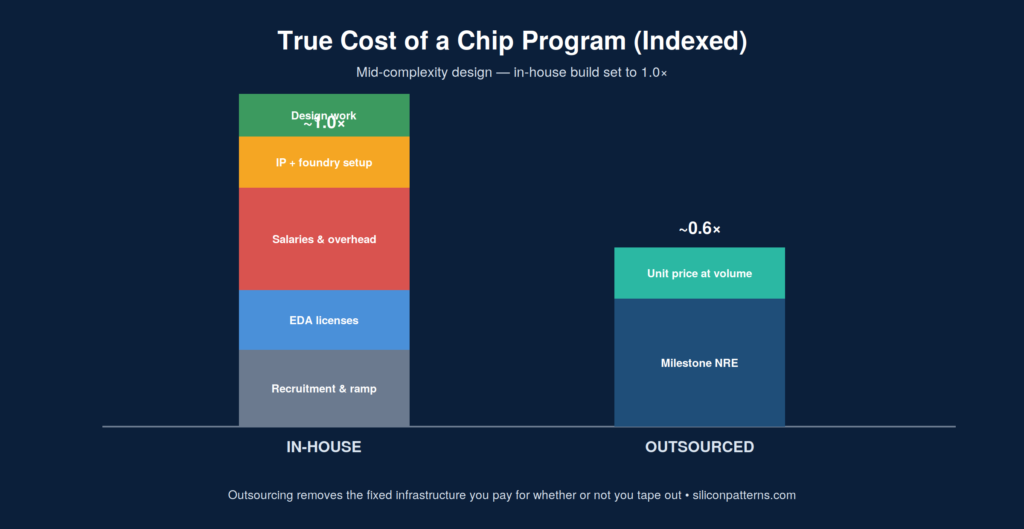
For a single chip or an occasional program, that fixed cost almost never pays for itself. This is the core reason outsourced chip design services come in dramatically cheaper on a typical program — often around 40% less on an indexed basis — not because the engineering is cheaper by the hour, but because you’re not paying to build and maintain the whole factory.
Money is only half the comparison. The other half is time — and time in a chip program is money with a deadline.
The in-house penalty here is brutal and easy to overlook: before your team can design anything, you have to assemble the team. That ramp-up runs 12–18 months on its own, and it sits entirely in front of the 16–18 month design-and-tape-out timeline. An established outsourced partner, by contrast, is already ramped — tools, IP, and engineers in place — so month one is engineering, not recruitment.
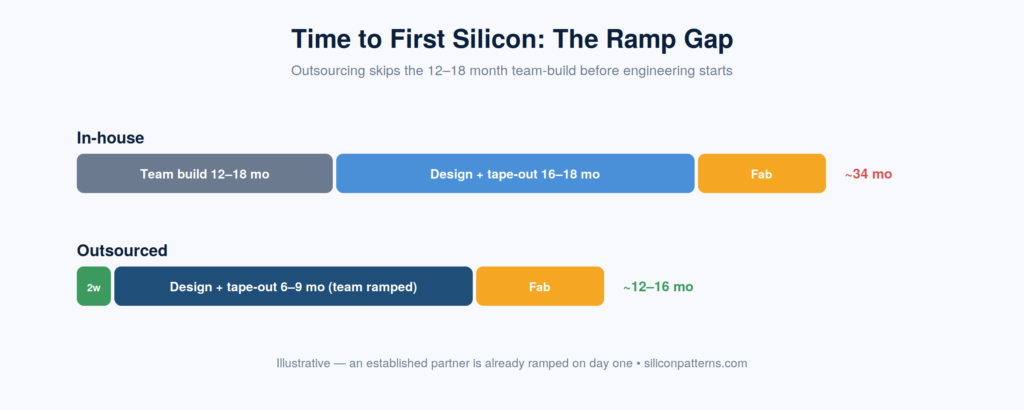
For a product racing a market window, that difference isn’t a line item — it’s the whole ballgame. Shipping a year earlier can be worth more than the entire design budget.
A fair comparison has to name the trade-offs, because outsourcing isn’t free of them.
You give up some direct control. Your design lives partly in another team’s hands, which demands trust and a genuine communication rhythm to work well. You take on vendor-management effort — though a true turnkey partner collapses that back down to a single relationship. And for a company shipping many chips a year over a long roadmap, the economics eventually flip: at sufficient scale, the fixed cost of an in-house team amortizes across enough projects to become the cheaper option per chip.
That last point is the real crux of the decision. Outsourcing wins decisively on any single program or modest roadmap. In-house wins once your volume is high enough and sustained enough to spread that heavy fixed cost thin. The question isn’t which model is “better” in the abstract — it’s which one your specific situation supports.
Strip away the noise and the decision comes down to a handful of honest questions about your business.
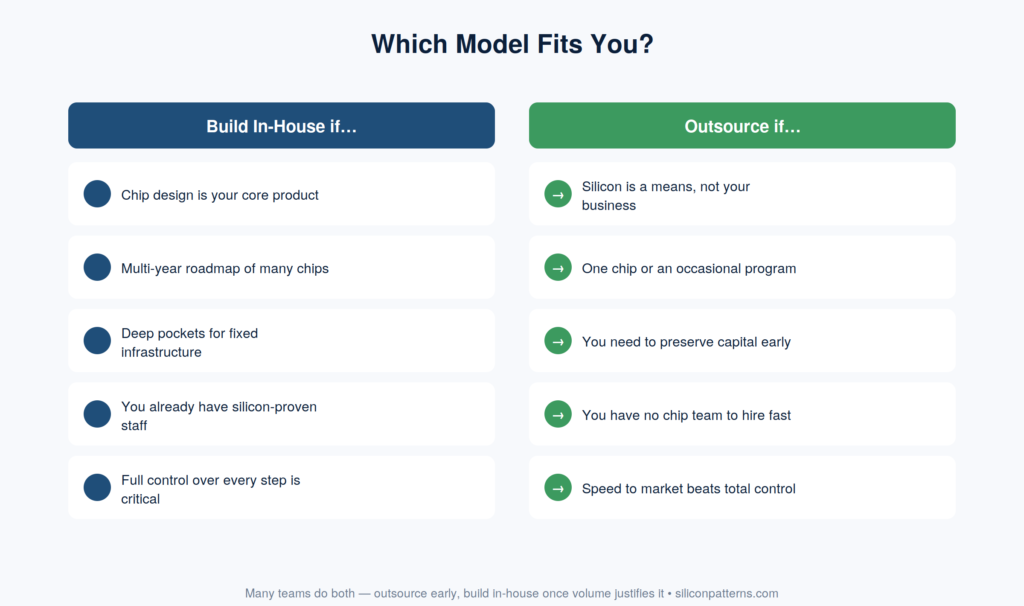
If chip design is your core product, you have a multi-year roadmap of many chips, deep pockets for fixed infrastructure, and silicon-proven staff already on hand — build in-house. The fixed cost will amortize and the control is worth it.
If silicon is a means rather than your business, you’re building one chip or an occasional program, you need to preserve capital early, or you simply can’t hire a chip team fast enough to hit your window — outsource. You’ll ship faster and spend less to get there.
The in-house-versus-outsourced framing is a little too binary, because the smartest teams often do both — and it’s frequently the best answer of all.
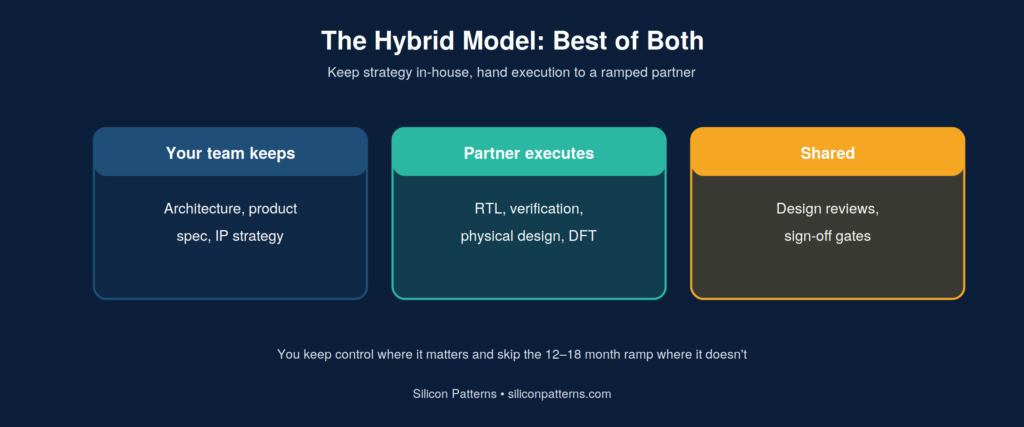
In a hybrid model, you keep the high-value strategic work — architecture, product definition, IP strategy — inside your own walls, and hand the execution-heavy stages (RTL, verification, physical design, DFT) to a partner who’s already ramped. You keep control where it genuinely matters and skip the 12–18 month build where it doesn’t.
This is exactly what flexible engagement models are built for. A turnkey ASIC partner can take your program from spec all the way to shipped, qualified silicon under one contract — or slot into your existing flow to own just verification, physical design, or DFT as a clean scope. You dial the ratio to fit your team and your budget, and you keep 100% of the IP either way.
Rules of thumb only get you so far. To compare in-house and outsourced chip design services for your specific chip, price out the full picture on the in-house side — not just salaries, but 12–18 months of ramp, annual EDA licenses, IP licensing or development, and foundry setup — and set it against a scoped, milestone-based quote from an outsourced partner. Then weigh in the time-to-market value of shipping a year sooner, which for many products dwarfs the engineering delta entirely.
The pattern that holds across almost every project we’ve seen: for a single chip or a modest roadmap, outsourcing wins on both cost and speed, usually by a wide margin. In-house only pulls ahead once you’re running enough volume, over enough years, to justify carrying all that fixed cost yourself.
Is it cheaper to outsource chip design or build an in-house team? For a single chip or an occasional program, outsourcing is almost always cheaper — often around 40% less on an indexed basis — because you avoid the fixed cost of team ramp, EDA licenses, IP, and foundry setup that you’d pay whether or not you tape out. In-house only becomes cheaper per chip at high, sustained volume.
How much does it cost to set up an in-house chip design team? Beyond salaries, expect 12–18 months of recruitment and ramp, $1M–$3M per year in EDA tool licenses, plus IP licensing and foundry/OSAT account setup. That infrastructure is a large fixed cost carried continuously, independent of how many chips you produce.
How much faster is outsourced chip design? The biggest saving is the ramp: an in-house team takes 12–18 months to assemble before design even begins, while an established outsourced partner is already ramped and starts within weeks. On a market-sensitive product, shipping a year earlier can outweigh the entire design cost.
Can I outsource only part of my chip design? Yes — this is the hybrid model, and it’s very common. You keep architecture and IP strategy in-house and hand execution-heavy stages like verification or physical design to a partner. Flexible engagement models exist precisely so you can scope exactly the piece you need.
When does building in-house actually make sense? When chip design is your core business, you have a multi-year roadmap spanning many chips, you can absorb heavy fixed infrastructure cost, and you already employ silicon-proven engineers. At that scale, the fixed cost amortizes across enough projects to win on a per-chip basis.
The real cost comparison between in-house and outsourced chip design services was never salary versus hourly rate. It’s the total picture: the year-plus of team ramp, the seven-figure tool licenses, the IP, the foundry setup, and the fixed overhead you carry every month — set against a scoped, pay-as-you-go engagement with a partner who already owns all of it.
For most companies building one chip or a modest roadmap, outsourcing wins on cost and speed, and a hybrid model lets you keep control exactly where it counts. In-house earns its keep at sustained high volume, and not much before.
If you’re weighing the two for a real project and want an honest read on what each would cost you, explore our semiconductor design services or our end-to-end turnkey ASIC solutions — or send us your requirement and we’ll model the numbers against your target volumes, no commitment required.

From ASIC architecture to GDSII tape-out — talk to our engineering team today.
Let’s Build Your Next Chip Together.