
Inactive
Simplifying IT
for a complex world.
Platform partnerships
- AWS
- Google Cloud
- Microsoft
- Salesforce

If your product has outgrown off-the-shelf silicon, you already know why custom IC & VLSI design services exist. This guide covers everything you need to make a confident decision — what the design process actually looks like, what kinds of custom IC & VLSI design services are available, what is reshaping the industry in 2026, and how to choose the right partner before things get expensive.

Custom IC & VLSI design services refer to the end-to-end engineering support required to take a chip from an idea to a manufactured device. VLSI — Very Large-Scale Integration — is the discipline of packing hundreds of millions of transistors onto a single piece of silicon. Custom IC design is the application of that discipline to build a chip around your specific product requirements, not the requirements of a general market.
Every transistor in a custom chip serves a purpose you defined. There is no wasted die area, no unnecessary power draw, no performance ceiling imposed by a microcontroller designed to be useful to everyone and optimal for no one.
The companies winning the hardest hardware markets in 2026 — AI inference at the edge, automotive ADAS, high-efficiency IoT, 5G infrastructure — are winning because they own their silicon. Apple, Google, Tesla, Amazon: all run their most competitive products on chips they designed themselves. Custom IC & VLSI design services are how you get there without building a 500-person chip team.
These three terms appear constantly in conversations about custom silicon. They are not interchangeable.
VLSI (Very Large-Scale Integration) is the engineering discipline — the science of designing chips with billions of transistors. When someone offers VLSI design services, they are offering the expertise to execute this discipline.
ASIC (Application-Specific Integrated Circuit) is the product. A chip built to do one thing, optimised relentlessly for that one thing. ASICs are the output of custom IC & VLSI design services applied to a specific problem.
FPGA (Field-Programmable Gate Array) is a programmable chip you can reconfigure after manufacture. Useful for prototyping and low volumes. At scale, it loses on power, cost per unit, and performance against a custom ASIC every time.
Here is how they compare on the dimensions that matter when you are making the call:
NRE Cost: Custom ASIC design runs from $500K to several million depending on node complexity. FPGA has negligible upfront cost.
Unit Cost at Volume: ASICs win decisively past 50,000 to 100,000 units. FPGAs remain expensive per unit regardless of volume.
Power Efficiency: A custom ASIC built for a specific workload can achieve 5 to 10 times better power efficiency than an FPGA running the same algorithm.
Time to First Silicon: ASIC takes 12 to 36 months. FPGA can be running your design in weeks.
IP Protection: Custom ASIC is a black box. FPGA offers only partial protection.
If you are evaluating custom IC & VLSI design services, you are likely past the FPGA phase. The question is when to move, not whether.
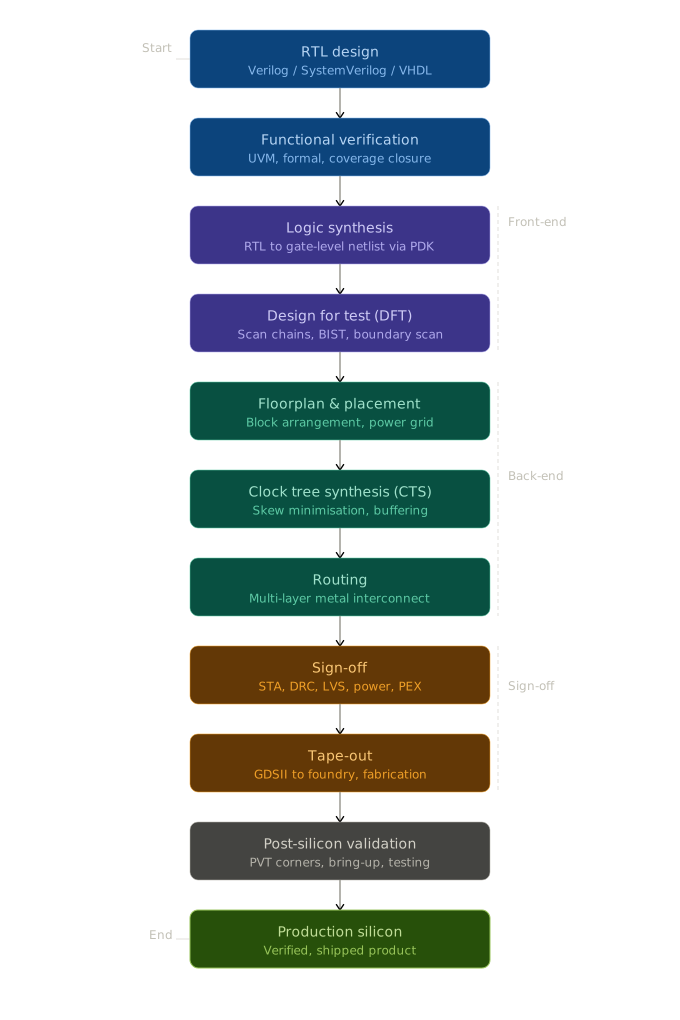
The full ASIC design flow — from RTL code to the GDSII file that goes to the foundry — is the backbone of every custom IC & VLSI design services engagement. Here is what each step actually involves:
The most important step and the source of the most expensive mistakes. You define what the chip must do, what it cannot do, and the constraints it must operate within: frequency targets, power envelope, die area, I/O interfaces, process node, temperature range. Every tradeoff made here echoes through every step downstream.
Engineers write the chip’s logic in Verilog, SystemVerilog, or VHDL at the Register Transfer Level. RTL is the chip’s DNA. Clean, well-structured RTL synthesizes into efficient silicon. Sloppy RTL causes timing problems, area bloat, and pain that compounds at every subsequent stage.
The RTL gets tested exhaustively before a single gate gets placed. Industry standard practice uses UVM methodology with constrained-random simulation, coverage-driven verification, and formal property checking. Bugs found here cost an afternoon. Bugs found after tape-out cost a million dollars and six months of schedule.
Synthesis tools — Synopsys Design Compiler, Cadence Genus — translate RTL into a gate-level netlist using standard cells from the foundry’s Process Design Kit, optimised for your PPA targets: performance, power, and area.
Scan chains, Built-In Self-Test structures, and boundary scan logic get inserted before physical design. A chip that cannot be tested efficiently after fabrication creates yield problems, quality problems, and field return problems that follow you for the product’s entire life.
This is where the chip becomes real. Floorplanning, placement, clock tree synthesis, and routing transform the netlist into a physical layout. At advanced nodes below 7nm, this requires managing congestion, electromigration, IR drop, and process variation simultaneously. Physical design is the step where custom IC & VLSI design services experience pays for itself most visibly.
Static timing analysis, power analysis, DRC, LVS, and parasitic extraction all have to pass before the GDSII file goes to the foundry. Tape-out is the point of no return. Eight to sixteen weeks later, you have physical silicon.
The fabricated chip gets tested across voltage, temperature, and process corners on real hardware. This phase almost always surfaces something. The question is whether it is a firmware fix or an expensive respin.
Not every custom IC & VLSI design services engagement looks the same. Here is the full landscape of what serious design services firms offer:
End-to-end RTL-to-GDSII execution for processors, DSPs, AI accelerators, communication controllers, and custom logic. This is the broadest category and the one most companies need when they decide to go custom.
ADCs, DACs, PLLs, LDOs, bandgap references, trans-impedance amplifiers, RF front-ends. Analog design has no synthesis safety net — every transistor gets sized manually and simulated across every process, voltage, and temperature corner. Experience here is irreplaceable.
System-on-Chip design integrates CPU cores, memory controllers, custom accelerators, and analog front-ends into a single device. The challenge is making every block work together — at high bandwidth, within a shared power budget, without interference.
Backend execution services for clients with strong front-end teams who need help closing timing, finishing routing, and getting to sign-off cleanly.
Verification consumes more engineering hours than RTL implementation at leading-edge nodes. Dedicated DV services using UVM, SystemVerilog Assertions, formal methods, and emulation help teams close coverage without leaving bugs in the design.
Silicon-proven, reusable IP blocks — SerDes, DDR PHY, PCIe, USB, memory compilers — reduce risk and accelerate tape-out compared to building every function from scratch on every project.
Silicon Patterns covers every one of these areas. See the full breakdown on our Silicon Engineering page.
AI Inside the Design Tools
Machine learning is now embedded throughout the VLSI design flow. ML-assisted floorplan exploration, congestion prediction, and routing optimisation are delivering 25 to 40 percent reductions in design cycle time for teams using AI-powered EDA tools from Cadence, Synopsys, and Siemens EDA. This directly reduces the cost and schedule risk of custom IC & VLSI design services engagements.
The assumption that more functionality means a bigger die is breaking down. Chiplet-based designs use multiple smaller dies on different process nodes, connected through advanced packaging — UCIe, 2.5D interposers, 3D stacking. AMD’s EPYC processors, Intel’s Meteor Lake, and Apple’s M-series all use multi-die approaches. The yield and flexibility advantages are compelling for any high-complexity design.
Every major hyperscaler is building its own AI accelerator. Google TPUs, Amazon Trainium and Inferentia, Microsoft Maia, Meta MTIA. The reason is simple: a neural processing unit designed specifically for a given inference workload outperforms a general-purpose GPU on that workload at a fraction of the power cost. This trend is cascading to edge devices, creating strong demand for custom NPU designs.
In 2026, RISC-V is no longer the promising-but-not-quite-ready open-source ISA. The toolchain is solid. The ecosystem is mature. The ability to customise the core architecture for specific workloads — without ARM licensing fees — has become a real competitive lever. RISC-V-based designs are shipping in storage controllers, AI accelerators, and automotive safety processors.
Battery life. Thermal envelope. Energy cost at data center scale. Every design conversation in 2026 starts with power. Low-power techniques — power gating, voltage scaling, near-threshold operation, fine-grained clock gating — are now first-class concerns from architecture through physical design, not afterthoughts added at sign-off.
For more on how these trends affect product strategy, see our work with AI engineering and NPU design and automotive semiconductor engineering.
A wrong choice here does not just affect one project. It affects your roadmap, your funding round, your customer relationships, and sometimes your company. Here is what separates the partners worth working with from the ones who look good in a pitch:
Fragmented engagements kill projects. When front-end and backend work are split across two vendors, you get coordination overhead, communication gaps, and no single party accountable for the outcome. The team that wrote the RTL should care about whether physical design is meeting timing. End-to-end capability under one roof produces better chips and clearer accountability.
There is a large difference between a team that has read the design manual for a 7nm process and a team that has done five tape-outs at 7nm and knows what the manual does not cover. Ask for tape-out history. Ask which foundries. Ask about first-pass success rate.
Cadence Virtuoso for analog, Cadence Innovus or Synopsys IC Compiler II for physical design, Mentor Calibre for sign-off. These are the tools your foundry expects. A partner working with unfamiliar or evaluation-license toolchains introduces risk that shows up at the worst possible time.
A partner with characterised, taped-out IP — DDR interfaces, SerDes, bandgap references, memory compilers — reduces risk and schedule on every function it covers. This is one of the most undervalued selection criteria in vendor evaluation.
Your GDSII, your RTL, your test vectors, and your characterisation data belong to you. This must be unambiguous in the contract before any work begins. Know exactly what you own before you sign.
Technical capability without honest communication is a recipe for a difficult engagement. The best indicator of this is how a potential partner communicates during the evaluation process. If they are sloppy before they have your business, it does not improve after the contract is signed.
Learn more about how Silicon Patterns approaches system design and SoC integration and why clients choose us on our Why Us page.
Digital VLSI has benefited enormously from automation. Synthesis tools, place-and-route tools, and timing analysis tools do a tremendous amount of work that once required expert manual effort. The tools are not perfect, but they have compressed the gap between a mediocre digital designer and a strong one.
Analog design has no such safety net.
An ADC converting a sensor signal, a PLL locking a reference frequency, an LDO maintaining a stable supply voltage — these circuits must work correctly in silicon on the first attempt. There is no firmware update for a bandgap reference with the wrong temperature coefficient.
The analog designer needs deep physical intuition about how transistors behave in the real world — across manufacturing variation, temperature extremes, and the supply voltage range the product will actually see in the field. They design with margin, which means understanding where margins are tight before simulation confirms it.
In 2026, demand for experienced analog mixed-signal designers is at an all-time high. Edge AI devices need high-efficiency PMICs. Automotive ADAS chips need precision sensor interfaces that work from minus 40 to 150 degrees Celsius. 5G infrastructure requires ultra-low-noise RF circuits at millimeter-wave frequencies. If your product touches the physical world — sensors, communications, power conversion, audio, imaging — your chip has analog content, and that analog content needs to be taken as seriously as the digital blocks that tend to get more attention. Silicon Patterns’ silicon engineering services cover full analog and mixed-signal design from schematic through PEX sign-off.
Silicon Patterns delivers custom IC & VLSI design services across the full stack — digital ASIC design, analog and mixed-signal, SoC integration, physical design, and design verification — with a team that has real tape-out history and the engineering discipline to match.
We work with product teams who need a partner that understands their business constraints, not just their technical requirements. That means being honest when a specification is unrealistic, raising problems before they become schedule risks, and treating your tape-out date as a commitment.
We have supported 35+ global clients, maintained a 98% satisfaction rate, and delivered 5+ tape-outs per year across semiconductor fabless companies, automotive electronics suppliers, IoT device makers, and AI hardware teams. If you are evaluating custom silicon for a new product, moving an existing FPGA design to ASIC, or working through a design challenge your current approach is not solving — we want that conversation

From ASIC architecture to GDSII tape-out — talk to our engineering team today.
Let’s Build Your Next Chip Together.