
Inactive
Simplifying IT
for a complex world.
Platform partnerships
- AWS
- Google Cloud
- Microsoft
- Salesforce

A leading semiconductor company engaged our verification team to perform formal verification and low-power validation for a Secure Boot Unit (SBU) within a next-generation SoC platform. The Secure Boot Unit plays a critical role in establishing the hardware root of trust, ensuring that only authenticated firmware and software are executed during system initialization.
Given the security-sensitive nature of the block and its interaction with multiple power domains, the verification process required a rigorous methodology combining formal verification techniques and low-power intent validation using UPF.
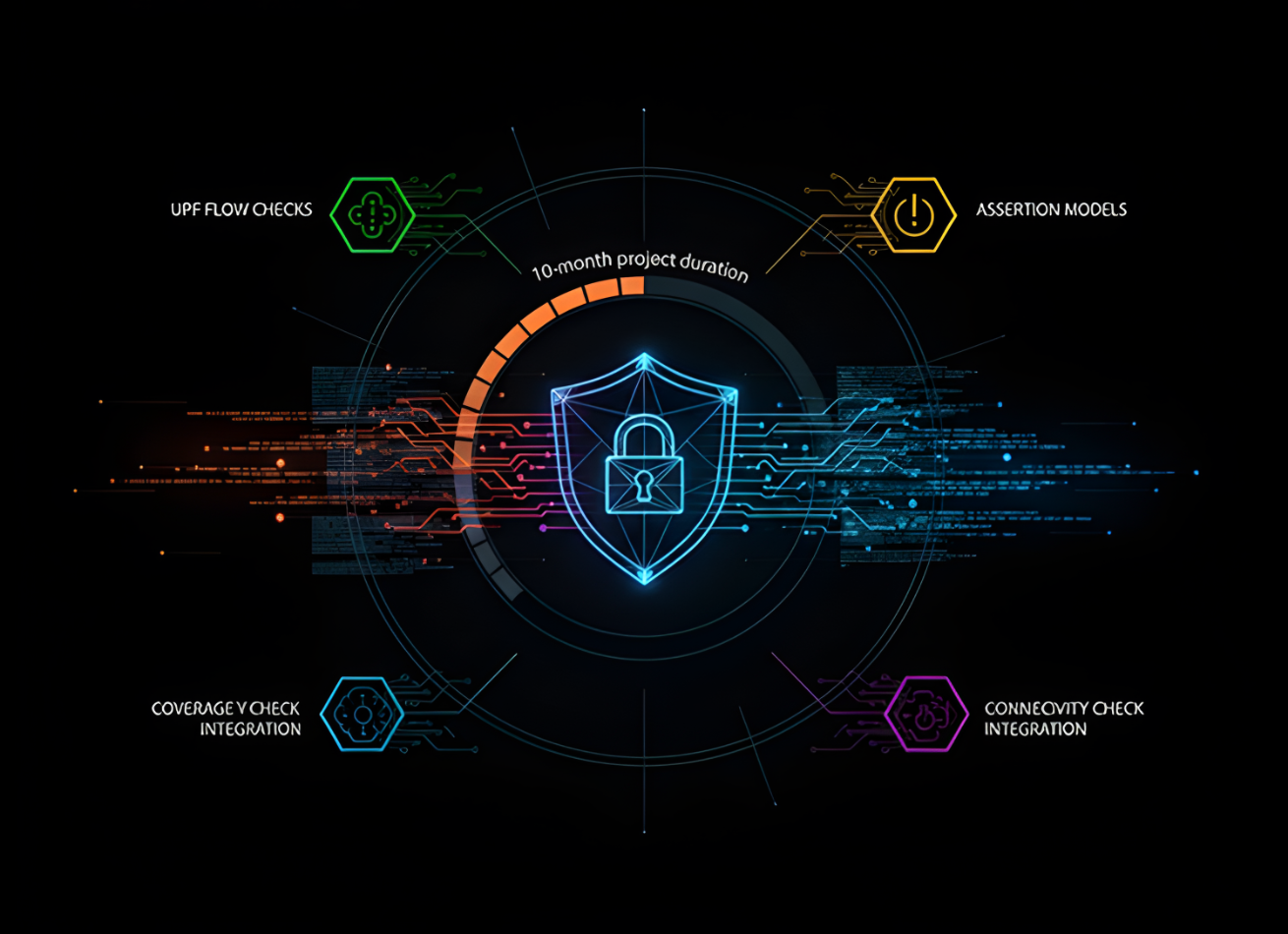
Our team developed a robust verification environment that integrated connectivity checks, assertion-based verification, and low-power formal validation to ensure the design met both functional correctness and power management requirements.
The Secure Boot Unit operates as a critical security component within the SoC, responsible for verifying firmware integrity and enforcing hardware security policies. The complexity of the design and its interaction with other system blocks introduced several verification challenges.
Key challenges included:
Ensuring secure boot logic correctness using formal verification methodologies
Validating low-power intent using UPF across multiple power domains
Modifying existing testbench infrastructure to support formal verification flows
Integrating connectivity checks across security and power control paths
Developing assertion-based models to validate security conditions and protocol behavior
Achieving complete coverage closure across connectivity and power scenarios
Additionally, the verification process needed to ensure that the Secure Boot Unit behaved correctly during power transitions, reset sequences, and security state changes.
To address these challenges, our verification experts implemented a structured formal verification methodology that combined assertion-based verification with low-power intent validation.
A comprehensive formal verification environment was built using assertion-based verification techniques to validate critical security properties and design correctness. Assertions were developed to validate protocol compliance, secure state transitions, and error conditions.
UPF-based verification methodologies were implemented to validate power intent across the Secure Boot Unit. This ensured correct operation during power gating, isolation, and retention scenarios.
Existing simulation environments were enhanced with formal verification capabilities, allowing the verification team to integrate connectivity checks and automated assertion monitoring.
Connectivity checks were implemented to validate signal integrity across security control paths and power management interfaces, ensuring reliable communication between the Secure Boot Unit and other system components.
Formal verification coverage metrics were monitored to ensure all security conditions, connectivity scenarios, and power state transitions were validated effectively.
Formal Verification
SystemVerilog Assertions (SVA)
UPF (Unified Power Format)
Connectivity Verification
Low Power Intent Validation
Coverage Analysis Tools
Industry-standard EDA Verification Platforms

From ASIC architecture to GDSII tape-out — talk to our engineering team today.
Let’s Build Your Next Chip Together.