Explore the latest physical design trends for AI accelerators, including advanced node scaling, 3D ICs, chiplets, and power optimization strategies.
Physical Design Trends for AI Accelerators
Artificial Intelligence is no longer confined to research labs. From hyperscale data centers to edge inference devices, AI accelerators are redefining compute infrastructure.
According to industry reports from the Semiconductor Industry Association, global semiconductor demand continues to surge due to AI-driven compute requirements.
This rapid expansion is pushing silicon engineering teams to rethink physical implementation methodologies at advanced process nodes. While architectural innovation drives algorithmic efficiency, it is the backend physical design that ultimately determines performance, power, area (PPA), and silicon reliability.
1. Advanced Node Scaling: Beyond 5nm
AI accelerators demand extreme transistor density and high-frequency operation. Foundries such as TSMC continue advancing 3nm and 2nm technologies, enabling higher performance per watt.
However, advanced-node physical design introduces:
- Increased routing congestion
- Complex multi-patterning constraints
- Variation-aware timing closure
- Stringent electromigration limits
Advanced node physical design for AI chips now requires:
- Early congestion-driven floorplanning
- Hierarchical implementation strategies
- EM/IR co-analysis during placement
- Automated sign-off convergence flows
Backend teams must integrate manufacturability awareness from day one.cialized engineering discipline requiring deep tool expertise and architectural awareness.
2. Chiplet Architecture & Advanced Packaging
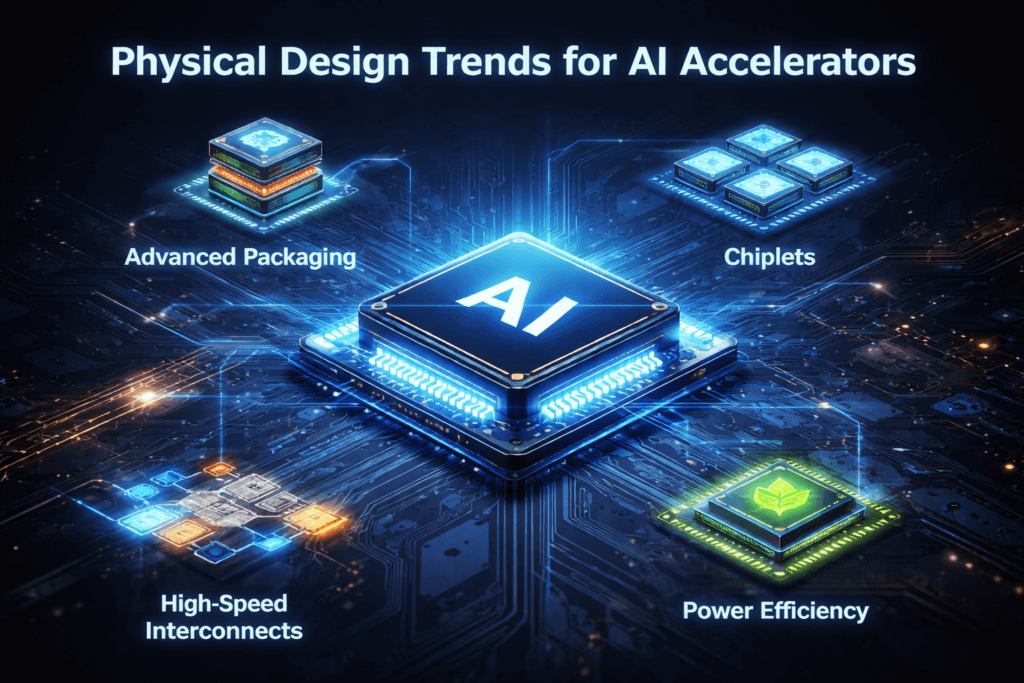
Monolithic scaling is no longer always cost-effective. The industry is rapidly transitioning toward chiplet-based AI accelerator design.
Instead of one massive die, AI accelerators are now built using multiple smaller dies connected through:
- 2.5D interposers
- 3D IC stacking
- Advanced packaging substrates
This shift impacts physical design in several ways:
- Die-to-die interface placement becomes critical
- Signal integrity across high-speed interconnects must be validated
- Thermal hotspots increase due to vertical stacking
- Package-aware design becomes mandatory
3. Power Integrity as a Primary Design Constraint
AI accelerators operate under massive switching activity due to matrix multiplications and tensor operations. This creates:
- Severe IR drop challenges
- Dynamic voltage droop
- Localized thermal density
Low power physical design techniques for AI accelerators now include:
- Multi-domain power planning
- Dynamic voltage frequency scaling (DVFS) support
- Advanced power grid mesh optimization
- Decap insertion automation
Power integrity simulation is no longer a sign-off step — it is integrated throughout the design flow.
4. High Bandwidth Memory (HBM) Integration
Memory bandwidth is the bottleneck of AI computation. Integration of HBM stacks changes backend implementation dramatically.
Key physical design considerations:
- Micro-bump placement accuracy
- Timing synchronization across memory channels
- Crosstalk management
- Thermal coupling analysis
AI SoC backend design challenges increasingly revolve around memory-to-compute proximity optimization.
5. Congestion-Driven Floorplanning
AI accelerators contain:
- Thousands of MAC units
- Deep pipeline buffers
- Large SRAM blocks
- Complex NoC fabrics
Without intelligent floorplanning, routing congestion can destroy timing closure.
Modern approaches include:
- ML-assisted placement optimization
- Hierarchical physical design methodologies
- Early global routing prediction
- Congestion heatmap analysis
Interestingly, AI is now being used to design better AI hardware.
6. 3D IC and Vertical Integration
3D IC integration in AI hardware is unlocking new levels of performance per watt.
Advantages include:
- Reduced interconnect delay
- Smaller footprint
- Higher bandwidth density
However, it also introduces:
- Thermal stacking issues
- TSV planning complexity
- New reliability models
Recent technical publications available on IEEE Xplore highlight how advanced placement algorithms and ML-assisted routing are improving multi-die integration efficiency.
Physical verification for AI hardware must now include thermal-aware analysis, mechanical stress checks, and multi-die DRC validation.
7. AI-Driven EDA Automation
One of the most exciting trends is the integration of AI within EDA tools themselves.
AI-driven backend optimization enables:
- Automated congestion resolution
- Predictive timing closure
- Smart ECO generation
- Faster design convergence
High-performance ASIC physical implementation cycles are being shortened significantly using intelligent automation.
8. Reliability and Long-Term Silicon Health
AI accelerators often run 24/7 in data centers. Long-term reliability is critical.
Physical design teams must address:
- Electromigration (EM)
- Bias temperature instability (BTI)
- Self-heating effects
- Aging-aware timing models
Reliability-aware physical implementation ensures silicon longevity in high-performance AI deployments.
Conclusion: Engineering the Future of AI Silicon
Physical design trends for AI accelerators are redefining what is possible in silicon engineering. From advanced node scaling and chiplet integration to AI-assisted automation and 3D IC stacking, backend implementation has become the performance backbone of modern AI systems.
As AI workloads grow more demanding, success will depend not only on architecture innovation but also on meticulous physical implementation, power integrity planning, and reliability-driven design methodologies.
At Silicon Patterns, we specialize in advanced ASIC and SoC physical design services tailored for next-generation AI accelerators. Our expertise in advanced node implementation, low-power design optimization, congestion-driven floorplanning, and sign-off closure enables clients to transform complex AI architectures into production-ready silicon.
If you are building high-performance AI hardware and need precision-driven backend execution, Silicon Patterns is ready to partner with you in shaping the future of intelligent silicon.