
If you’ve ever wondered how a chip idea transforms into a physical silicon die ready for mass production, you’re in the right place. The ASIC design flow is a structured, multi-stage engineering process that takes a designer’s logic description — written in RTL — all the way down to a GDSII file that a semiconductor foundry uses to manufacture the chip.
Whether you’re an engineering student, a product manager scoping a custom chip project, or a startup founder evaluating ASIC vs FPGA for your next product, this guide breaks down every critical stage of the ASIC design flow in plain, practical language.
• Key tools used at each stage
What You’ll Learn
The complete RTL-to-GDSII flow
• Common pitfalls and how to avoid them
• How professional teams manage sign-off
What Is an ASIC — and Why Does the Design Flow Matter?
An Application-Specific Integrated Circuit (ASIC) is a chip designed for one specific purpose rather than general-purpose computing. Unlike FPGAs — which can be reconfigured after manufacturing — an ASIC is permanently fixed once fabricated. This trade-off delivers massive benefits: lower power consumption, higher performance, smaller die area, and lower per-unit cost at scale.
But the price of those benefits is complexity. An ASIC tape-out is a one-shot process. Any bug that slips through to silicon means expensive re-spins, missed market windows, and wasted NRE (Non-Recurring Engineering) costs. That’s exactly why the ASIC design flow exists — a carefully sequenced series of steps, checks, and sign-off criteria to guarantee your chip works before a single wafer is etched.
The ASIC Design Flow at a Glance
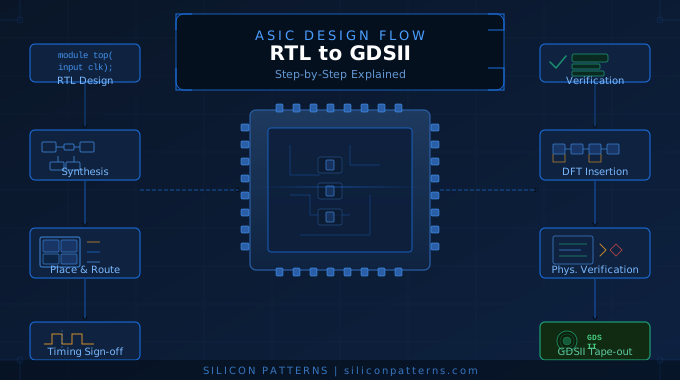
Here is a high-level view of every major stage from specification to GDSII hand-off:
| Stage | Key Activity | Output |
|---|---|---|
| 1. Specification | Define functionality, power, timing, and area targets | Design Specification Doc |
| 2. RTL Design | Write synthesizable hardware description (Verilog/VHDL) | RTL Code |
| 3. Functional Verification | Simulate RTL, run testbenches, achieve coverage closure | Simulation Reports |
| 4. Synthesis | Convert RTL to gate-level netlist for target library | Gate-Level Netlist |
| 5. DFT Insertion | Add scan chains, BIST, boundary scan for testability | DFT Netlist |
| 6. Floorplanning | Define die area, I/O placement, macro placement | Floorplan DEF |
| 7. Place & Route (PnR) | Auto-place standard cells and route all metal connections | Routed Netlist + DEF |
| 8. STA (Timing Sign-off) | Verify setup/hold slack across all corners and modes | Timing Reports |
| 9. Physical Verification | Run DRC, LVS, ERC for physical correctness | Clean DRC/LVS Reports |
| 10. GDSII Tape-out | Stream out final GDSII/OASIS to foundry | GDSII File |
Stage 1: Specification and Architecture Definition
Every chip starts with a clear problem statement. The specification phase defines what the ASIC must do, how fast it must do it, how much power it can consume, and what the die cost target is. This document drives every decision downstream.
Key questions answered at this stage include: What is the target process node (e.g., 28nm, 7nm, 5nm)? What are the interface protocols (PCIe, DDR, USB, AXI)? What are the PPA targets — Performance, Power, and Area? What is the operating voltage and temperature range?
📌 Pro Tip
Invest heavily in the specification. Bugs found during specification cost next to nothing to fix. The same bug found after tape-out can cost millions in re-spin NRE.
Stage 2: RTL Design (Register Transfer Level)
RTL design is where the logic is actually written. Engineers use Hardware Description Languages (HDLs) — primarily Verilog or SystemVerilog — to describe the circuit as a series of registers and the combinational logic that connects them.
Good RTL coding is about writing synthesizable, readable, and efficient logic. This means avoiding latches (unless intentional), keeping clock domain crossings controlled, and writing code that maps cleanly to the target standard cell library.
Common RTL Design Considerations
- Use synchronous design practices — avoid asynchronous resets where possible
- Clearly define all clock domains and CDC crossing points
- Write parameterized RTL for reusability
- Follow your organization’s coding guidelines (naming conventions, file structure)
- Enable lint checks early using tools like Spyglass or Jasper
Stage 3: Functional Verification
Functional verification is where the majority of the project timeline is spent — and for good reason. The goal is to confirm that your RTL does what the specification says it should do, across all possible input conditions, corner cases, and operating scenarios.
Modern ASIC verification uses the UVM (Universal Verification Methodology) framework to build constrained-random testbench environments. Coverage-driven verification ensures that both code coverage and functional coverage are closed before moving to synthesis.
Verification Techniques
- RTL simulation using tools like Cadence Xcelium, Synopsys VCS, or Mentor Questa
- Constrained-random stimulus generation with functional coverage closure
- Formal verification (property checking) for safety-critical blocks
- Emulation on platforms like Cadence Palladium or Synopsys ZeBu for system-level testing
- Gate-level simulation after synthesis for equivalence checking
External Reference: IEEE Standard for SystemVerilog — Unified Hardware Design and Verification (IEEE 1800) provides the authoritative standard for RTL and verification language.
Stage 4: Logic Synthesis
Logic synthesis is the automated process of converting your RTL description into a gate-level netlist using a standard cell library provided by the foundry. Synthesis tools — primarily Synopsys Design Compiler or Cadence Genus — parse the RTL, apply optimizations, and map the logic to actual physical gates.
The synthesis step also applies timing constraints from a Synopsys Design Constraints (SDC) file. These constraints define the clock frequencies, input/output delays, and multicycle paths. Getting the SDC right is critical — an incomplete or incorrect SDC leads to a chip that fails timing in silicon even when simulation says it passes.
Synthesis Optimization Goals
- Timing: Minimize critical path delay to meet frequency targets
- Area: Reduce total gate count to keep die costs competitive
- Power: Minimize switching activity using logic restructuring and clock gating
Stage 5: Design for Test (DFT) Insertion
A fabricated chip cannot be directly debugged the way software can. Design for Test (DFT) techniques insert controllability and observability structures into the design so that manufactured chips can be tested on Automatic Test Equipment (ATE).
Key DFT Techniques
- Scan insertion: Standard cells are connected into scan chains for shift-register-based testing
- MBIST (Memory Built-In Self-Test): Embedded test logic for SRAM and ROM macros
- JTAG / Boundary Scan (IEEE 1149.1): For board-level testing of I/O connectivity
- ATPG (Automatic Test Pattern Generation): Tool-generated patterns targeting stuck-at and transition faults
External Reference: Synopsys Design Compiler Documentation covers DFT integration during synthesis.
Stage 6: Floorplanning
Floorplanning is the first stage of the physical design flow. Here, the P&R team takes the gate-level netlist and begins placing it within the physical die boundary. This stage defines the chip’s physical architecture.
Floorplanning Activities
- Define the die size and core area based on timing and density targets
- Place large macros (SRAMs, analog IP blocks, PLLs) in their optimal positions
- Plan the power delivery network (PDN) — power rings, stripes, and well taps
- Define I/O pad placement to match the package and PCB pinout
- Estimate congestion hot spots and pre-route critical paths
A bad floorplan is very difficult to recover from. Time spent on floorplan exploration — including early PPA estimates using virtual hierarchies — pays dividends in every downstream stage.
Stage 7: Place and Route (PnR)
Place and Route (PnR), also called physical implementation, is the most computationally intensive stage of the ASIC design flow. Automated tools — Cadence Innovus, Synopsys IC Compiler II, or Siemens Calibre — take the post-floorplan design and place hundreds of millions of standard cells, then route all the metal interconnects between them.
PnR Sub-Stages
- Global Placement: Initial cell placement using force-directed or analytical algorithms
- Clock Tree Synthesis (CTS): Build a balanced, low-skew clock distribution network
- Legalization: Snap cells to grid and resolve overlaps
- Detailed Placement: Fine-tune cell positions to improve timing and routability
- Global Routing: High-level metal resource allocation
- Detailed Routing: Actual metal track assignment for every net
- Post-Route Optimization: Fix remaining DRC violations, improve timing, reduce IR drop
Stage 8: Static Timing Analysis (STA) and Sign-off
Static Timing Analysis (STA) is a formal method to verify that the design meets its timing requirements without running simulation. STA tools calculate the delay of every path from a launch flip-flop through combinational logic to a capture flip-flop, and check that setup and hold time constraints are satisfied.
Sign-off STA is performed at multiple process-voltage-temperature (PVT) corners — worst-case slow, best-case fast, and typical corners — using tools like Synopsys PrimeTime. On-Chip Variation (OCV) and AOCV modeling accounts for manufacturing variability across the die.
⚡ Key STA Concepts
Setup check: Data must arrive before the clock edge (critical for max frequency) • Hold check: Data must remain stable after the clock edge (critical for metastability) • Slack = Required Time − Arrival Time (positive slack = timing met)
Stage 9: Physical Verification (DRC, LVS, ERC)
Physical verification is the final quality gate before tape-out. It confirms that the physical layout is both manufacturable and electrically equivalent to the intended design.
The Three Pillars of Physical Verification
- DRC (Design Rule Check): Verifies that the layout obeys the foundry’s manufacturing rules — minimum spacing, width, enclosure, and density rules. Tools: Siemens Calibre DRC, Cadence PVS, Synopsys IC Validator.
- LVS (Layout vs. Schematic): Compares the extracted netlist from the layout against the schematic netlist. Confirms connectivity is preserved exactly.
- ERC (Electrical Rule Check): Flags electrical issues like floating nodes, antenna violations, and electromigration risks.
Physical verification must return a completely clean report — zero DRC errors, LVS clean — before the foundry will accept the tape-out. Even a single unresolved error can cause wafer yield loss.
Stage 10: GDSII Tape-out
GDSII (Graphic Data System II), now increasingly in OASIS format, is the industry-standard layout format that encodes the complete chip geometry — every polygon on every metal layer. When all sign-off checks pass, the design team streams out the GDSII to the foundry. This moment is called tape-out.
The foundry uses the GDSII file to generate photomasks — the stencils that transfer the circuit patterns onto silicon wafers through the photolithography process. Weeks to months later, packaged silicon samples arrive for bringup and characterization.
SEMI P10 Standard: GDSII Stream Format is the formal specification for the tape-out file format accepted by foundries worldwide.
Common ASIC Design Flow Pitfalls — and How to Avoid Them
| Common Pitfall | How to Avoid It |
|---|---|
| Incomplete SDC constraints | Review SDC against all clock domains; use lint tools on constraints early |
| Clock Domain Crossing (CDC) bugs | Use formal CDC analysis tools (Mentor CDC) at RTL stage |
| Floorplan congestion hot spots | Run congestion analysis during floorplanning; explore macro placement alternatives |
| DRC waived items causing yield loss | Never waive DRC without a documented waiver approval and yield analysis |
| Sign-off timing with wrong corners | Check with foundry for correct MMMC (Multi-Mode Multi-Corner) setup |
| Late DFT insertion | Insert DFT at synthesis stage; test coverage should be >99% at tapeout |
Key EDA Tools Used in the ASIC Design Flow
The ASIC design flow relies on a tightly integrated suite of Electronic Design Automation (EDA) tools. The three dominant EDA vendors are Synopsys, Cadence Design Systems, and Siemens EDA (formerly Mentor Graphics).
Synopsys
- Design Compiler / DC Ultra — Logic synthesis
- VCS — RTL and gate-level simulation
- PrimeTime — Sign-off static timing analysis
- IC Compiler II — Physical implementation (place and route)
Cadence Design Systems
- Genus Synthesis Solution — RTL-to-netlist synthesis
- Xcelium Parallel Simulator — RTL simulation and mixed-signal
- Innovus Implementation System — Physical design and optimization
- Tempus Timing Signoff Solution — STA sign-off
Siemens EDA
- Questa Simulation — Functional and UVM-based verification
- Calibre nmDRC / nmLVS — Industry standard physical verification
ASIC vs FPGA: When Does the Full Design Flow Make Sense?
FPGA prototyping is often the first step in any digital design project — and for good reason. FPGAs let teams validate functionality in real hardware before committing to the multi-million-dollar ASIC NRE cost. But at scale, or when power/performance requirements are strict, an ASIC is the right answer.
📊 Rule of Thumb
ASIC tape-out makes economic sense when: volume exceeds ~50,000–100,000 units per year, power consumption is a hard constraint (IoT, battery-powered devices), or performance requirements exceed what FPGAs can deliver.
Explore More From Silicon Patterns
Our team at Silicon Patterns covers the full spectrum of chip design and silicon engineering. Here are some related resources you may find helpful:
- → Silicon Engineering Services — Custom ASIC design, RTL development, and physical implementation services.
- → Embedded Solutions — Bridging the gap between silicon and software for your product.
- → System Design Services — Architecture through implementation for complex SoC and system platforms.
- → Automotive Solutions — ISO 26262-aligned chip design for next-gen automotive applications.
- → Read More on the Silicon Patterns Blog — Insights, tutorials, and industry perspectives from our engineering team.
Conclusion: The ASIC Design Flow Is a Team Sport
From RTL coding to GDSII tape-out, the ASIC design flow is one of the most demanding engineering journeys in all of technology. Each stage demands deep expertise, the right tooling, and an obsessive attention to quality — because in silicon, there’s no hot-fix deployment.
Whether you’re tackling RTL-to-GDSII for the first time or optimizing a mature product line for your next process node, understanding every stage of the flow empowers better decisions at every level — from individual engineers to executive stakeholders.
Partner With Silicon Patterns for Your Next ASIC Project
Silicon Patterns is a Hyderabad-based semiconductor engineering company specializing in end-to-end ASIC design services — from architectural specification and RTL development to physical implementation and silicon bring-up. Our team has delivered chips across consumer electronics, automotive, AI accelerators, and industrial IoT markets.
We bring together deep EDA expertise across Synopsys, Cadence, and Siemens toolchains, a rigorous sign-off methodology, and a collaborative engineering culture that keeps your project on schedule and on budget.
Whether you need a turnkey RTL-to-GDSII partner, a specialized verification team, or embedded hardware expertise — Silicon Patterns has the people and process to deliver.
Frequently Asked Questions
How long does a typical ASIC design flow take?
The timeline varies significantly based on design complexity, team size, and process node. A simple ASIC in a mature process node (28nm and above) might take 12–18 months from specification to tape-out. A complex SoC on an advanced node (7nm or below) can take 3–5 years.
What is the difference between RTL and netlist?
RTL (Register Transfer Level) is a behavioral description of the hardware written in Verilog or VHDL — it describes what the circuit does. A netlist is the structural representation after synthesis — it lists actual logic gates and their connections, tied to a specific standard cell library.
What does GDSII stand for?
GDSII stands for Graphic Data System II. It’s a binary file format used to describe the complete physical layout of an integrated circuit, including every polygon on every metal and polysilicon layer. It is the primary deliverable sent to a foundry for fabrication.
Can ASIC design be done without a foundry relationship?
Yes — fabless semiconductor companies design ASICs and then send GDSII files to pure-play foundries like TSMC, Samsung Foundry, or GlobalFoundries for manufacturing. A foundry relationship typically provides access to the Process Design Kit (PDK), which contains the standard cell libraries and design rules needed for the design flow.
What is the most common cause of ASIC re-spins?
The most common causes are functional bugs not caught during verification, timing failures under worst-case operating conditions, and physical issues such as electromigration or IR drop violations. This is why rigorous verification and sign-off processes are non-negotiable.