
Inactive
Simplifying IT
for a complex world.
Platform partnerships
- AWS
- Google Cloud
- Microsoft
- Salesforce
Explore how RISC-V is revolutionizing SoC design with open-source architecture, customization, low-power advantages, challenges, and industry adoption trends.
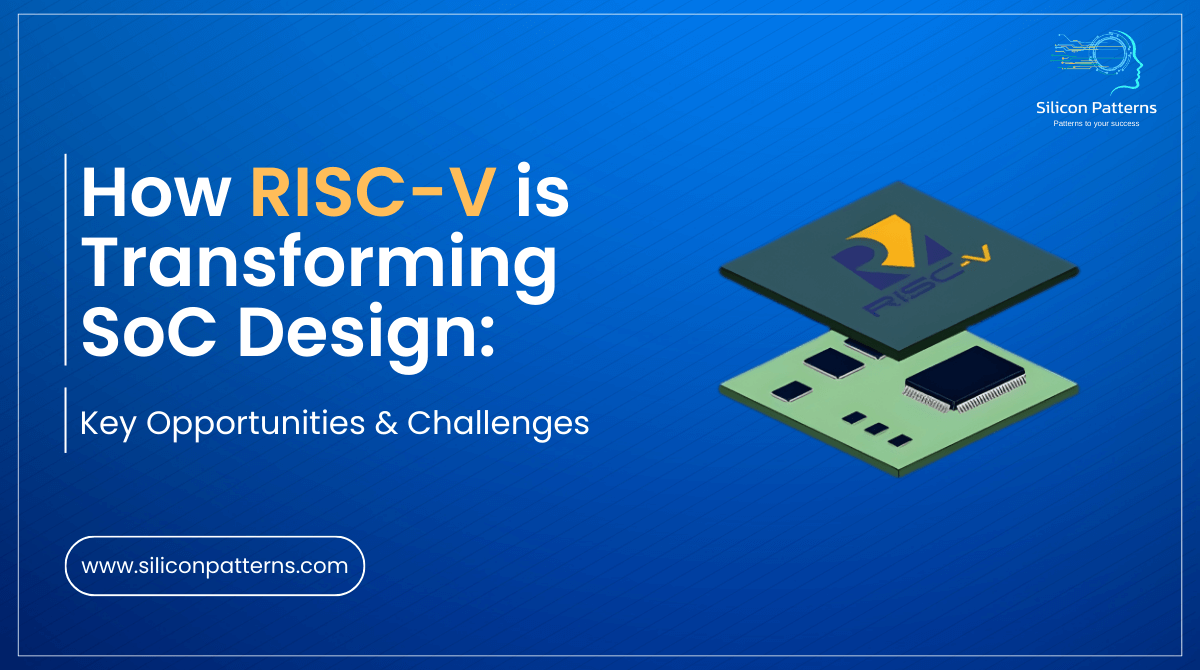
The semiconductor industry is undergoing a paradigm shift, and at the center of this innovation is RISC-V, the open-standard Instruction Set Architecture (ISA) reshaping how System-on-Chip (SoC) designs are conceptualized and built. With the rise of AI, Edge Computing, Automotive Electronics, and IoT, engineers today need architectures that are customizable, scalable, and cost-efficient. RISC-V delivers exactly that.
This blog explores how RISC-V is revolutionizing SoC design, the opportunities it unlocks, and the challenges organizations must navigate to adopt it successfully.
RISC-V is an open-source ISA, unlike proprietary architectures such as ARM or x86.
Being open means:
This allows SoC designers to tailor the processor architecture to specific workloads without depending on vendor-imposed restrictions.
RISC-V enables designers to rethink conventional SoC design in the following ways:
With RISC-V, companies can add custom instructions to accelerate:
This flexibility is especially important as the industry moves toward highly specialized SoCs.
Since RISC-V comes without restrictive licensing:
This accelerates development cycles—crucial for fast-moving markets.
Licensing proprietary architectures can be expensive.
RISC-V eliminates:
For startups and mid-size semiconductor companies, this is game-changing.
The RISC-V ecosystem now includes:
The rapid expansion makes enterprise adoption increasingly practical.
RISC-V’s modular design suits low-power applications due to:
Its simplicity makes it ideal for ultra-low-power IoT devices.
Designers can define workload-optimized architectures, enabling:
Security can be built natively into the ISA.
RISC-V allows adding:
This helps companies create chips aligned with modern cybersecurity needs.
A single RISC-V base can scale from:
This uniformity reduces engineering complexity and long-term costs.
With rising restrictions on proprietary chip architectures, RISC-V offers:
Countries and corporations alike view RISC-V as a path to architectural freedom.
While promising, RISC-V adoption comes with challenges engineers must plan for:
The openness of RISC-V brings risk of:
Standardization efforts are ongoing but still evolving.
ARM still leads in:
RISC-V is catching up, but the gap remains.
Custom instructions mean:
Proper verification frameworks are essential.
Although improving rapidly, challenges persist:
Organizations need experienced engineering teams to mitigate these hurdles.
The future of RISC-V is aligned with industry megatrends:
As ecosystem maturity improves, RISC-V will continue moving into:
Global semiconductor leaders are already investing heavily, indicating long-term growth.
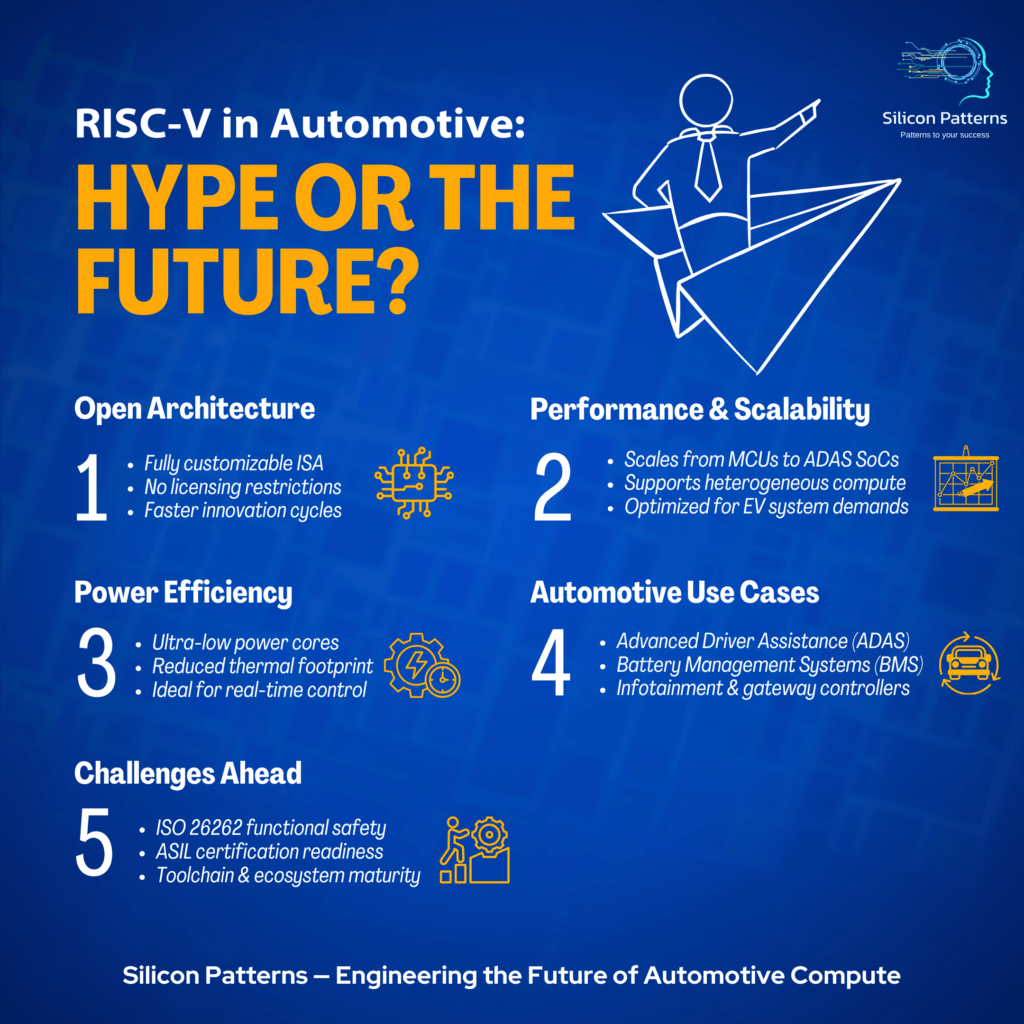
RISC-V represents a new era of open, flexible, and scalable SoC design, enabling companies to innovate faster while reducing dependency on proprietary architectures.
However, successful adoption requires deep expertise in Design Verification, Physical Design, Embedded Software Development, Post-Silicon Validation, and custom IP integration.
At Silicon Patterns, we specialize in delivering high-quality semiconductor engineering services tailored for next-generation architectures like RISC-V.
Our team supports end-to-end SoC development—from RTL to Signoff and Validation—helping companies accelerate innovation with precision, efficiency, and reliability.
If you’re exploring RISC-V-based SoC development, Silicon Patterns is ready to partner with you for a faster, smarter, and more scalable design journey.

From ASIC architecture to GDSII tape-out — talk to our engineering team today.
Let’s Build Your Next Chip Together.